


There are people who, after gaining weight and then losing it through exercise, end up looking even older. You may wonder whether these people can also see a big improvement. We interviewed Director Kim Hyun-cheol of Kidari Plastic Surgery Clinic, a hospital specializing in facelift surgery, about which types of people benefit from facelift surgery and how common facelift surgery is among people in their 40s.

The only unattractive part is the sagging of the face; if the eyes, nose, and mouth were originally pretty, once you remove all the wrinkles, the person looks beautiful. The effect is very noticeable. Another group that sees particularly good results are people whose bones are not bumpy—in other words, those with very smooth facial contours. You know the saying, “They’ve aged so gracefully.” For those people, just doing a facelift makes the face look younger, and their originally graceful features become even more beautiful.
People who are not very overweight also see good results. When someone who is quite overweight undergoes a facelift, the swelling lasts a long time. So for overweight patients, even though we pull the face just as much, because there is so much fat, we perform liposuction while tightening the face. If you simply pull and bunch up the fat, the cheeks and other areas can look chubby. That’s why we remove fat in those areas during surgery, but that in itself makes the postoperative swelling last longer. When swelling persists for a long time and goes up and down, the “latent period” becomes longer and the perceived effect is reduced. Compared to people who are overweight and undergo both facelift and liposuction, those who are not fat and only have loose skin see better results. Among thin people, those whose faces look very gaunt and aged also tend to get better results than overweight people after the surgery.
There are also people who used to be overweight but then lost weight through dieting or exercise. Those whose skin has become wrinkled and loose after losing weight tend to see very good results from a facelift. The reason is that, compared to people whose face is sagging simply because they are still chubby and the fat itself is hanging down, people who have already lost the excess fat only need the skin to be pulled tight. In such cases, the remaining fat looks just right, the uneven skin texture is smoothed out, and the swelling after surgery does not last long.
When there is a bit of swelling, they actually look even better—there is a phase where the slightly swollen look is the most attractive. That is why I say that these people often get especially good results.
Q. I watched your YouTube video about senior facelift surgery. Unlike middle‑aged patients, seniors often have deep wrinkles that have been there for a long time. Do they need to undergo facelift surgery multiple times?

No, they do not. Deep wrinkles form because the retaining ligaments inside the skin pull downward. For example, nasolabial folds or deep forehead wrinkles develop because the muscles repeatedly fold and unfold the skin throughout life. As a result, the subcutaneous tissue becomes thin and the fat layer diminishes.
In such cases, even if the skin is lifted, people often ask whether wrinkles will remain because the skin itself is thin. However, when the dissection is done cleanly, the tissue fills in again. In more severe cases, partial treatments like subcision can help stimulate volume restoration.
And even if the skin becomes thicker or thinner and some wrinkles remain after surgery, doing another surgery will not make the skin thicker again. Ultimately, the surgery is done once — everything necessary is completed at the same time, so there is no need for multiple surgeries.
Q. Many people in their 20s and 30s have sagging skin even without wrinkles. Would a facelift still be effective for them?
Young individuals generally have good skin elasticity — the skin contracts well. For example, when a woman gives birth to her first child, her abdominal skin still has elasticity, so it contracts quickly and becomes tight again like before pregnancy. But after the second child, the skin that stretched once stretches again, and the elastic ligaments and fibers become loosened. In such cases, even after giving birth, the skin does not fully recover. The same principle applies to the face.
If the skin still has elasticity, young people can achieve clean, wrinkle‑free results even with just liposuction because the skin contracts and adheres well. However, in older individuals whose skin has sagged and stretched, even if fat is removed through liposuction, the skin may not contract later, causing wrinkles to reappear.
Therefore, for younger people whose skin is simply sagging, liposuction combined with a small mini‑lift can provide long‑lasting results.
Q. How common is facelift surgery among people in their 40s?
These days, people often talk about pulling the fascia during facelift surgery. But more accurately, it is not the fascia itself — it is the muscle aponeurosis. In Korean, it is called the “superficial musculoaponeurotic system,” and in English, it is known as SMAS. You’ve probably heard the term SMAS many times. Some people think “pulling the fascia” means pulling something new, but it is essentially the same as pulling the SMAS. So, how much facelift surgery is typically done in the 40s? Usually, facial sagging begins in the late 30s. The first area to sag is the eyebrow and forehead region, then under the eyes, then the cheeks, followed by the neck, behind the ears, and eventually the double chin — all of this is part of the aging process. How much aging occurs by the 40s? It varies from person to person. Some people in their 30s look like they’re in their 60s, while some in their 60s look as firm as people in their 30s. But generally, Koreans age slowly. Westerners in their 40s often look very wrinkled and aged, but many Koreans in their 40s look like they’re in their 30s or even 20s.

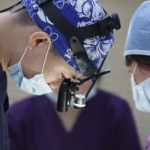
It seems that aging appears later especially in men. As shown in the photo, this person is also in his 40s, and the facelift he received was a non‑incisional lift.
This is called a midface lift. A small 2 cm incision is made in the temporal area to create a passage, then dissection is performed under the periosteum of the cheekbone. You know the white membrane you see when eating ribs? Muscles attach to that membrane. When surgery is performed between that membrane and the bone, there are no blood vessels in that layer, so there is no bleeding and dissection is easy.
The dissection extends all the way to the canine root, under the cheekbone, and to the maxilla. Near that area is what we call the “deep fat compartment.” As we age, this deep fat descends and creates what is known as the jowl. Through the dissected periosteum, we locate the jowl, lift it, and reposition it next to the zygomatic bone. As we age, the bone loses volume and the deep fat sags, forming jowls — lifting it restores the contour.
There is also a muscle near that area that lifts the corner of the mouth; we suspend that muscle as well. The nasolabial fold is also lifted. Then, a dissolvable hook‑like device called Endotine is anchored in the temporal area to secure the lift.
The skin is not cut or removed — it is simply closed as is. This patient underwent only this midface lift.

자료화면: 키다리성형외과 yutube 채널
In most cases, a temporal mini‑lift is performed together with the procedure, but for patients who do not have much skin sagging, we simply perform dissection and pull only the periosteum. Even though the skin itself is not pulled at all, a midface lift alone can lift the drooping mouth corners, sagging cheeks, and the front cheekbone area, making the face look brighter and smaller.
Ultimately, this patient only had a temporal midface lift. In addition, lower eyelid surgery (lower blepharoplasty) was performed to reposition the fat and create a youthful under‑eye area, and a brow‑lower forehead lift was also done — a total of three procedures.
For people in their 40s, this amount of surgery is usually enough. Even with just this, they look more than 10 years younger. And when a facelift is done properly at a younger age, the results last for a very long time. These patients also tend to age more slowly.
I explained this so you can get a sense of how much facelift surgery is typically done in the 40s. Thank you.
Discover more from Korea Doctor Interview
Subscribe to get the latest posts sent to your email.


Leave a Reply
You must be logged in to post a comment.
[…] 안면거상 이런 분들은 효과 좋습니다 Author […]