Do Home Lifting Devices Really Work? Principles and Proper Use of RF, HIFU, EMS, and LED

Interest in home lifting devices has been skyrocketing recently.
With the rise of various devices such as RF, ultrasound, EMS, and LED, messages claiming that “you can achieve lifting at home” are everywhere. However, accurate information about whether they truly work, how each device functions, and whether daily use is safe is still lacking.
In this article, we summarize the real effectiveness and proper use of home lifting devices based on a direct interview with Dr. Park Sooyeon, a board‑certified plastic surgeon and dermatologist at Made Young Clinic.

🔥 RF & HIFU — Leading lifting technologies that awaken collagen
The most commonly used technologies in home lifting devices are RF and HIFU. Both stimulate the deeper layers of the skin to promote new collagen production, but they differ slightly in how they work and how deep they reach.

✔ How RF (Radiofrequency) works
RF works by gently heating the dermis to stimulate collagen regeneration. This helps firm the overall skin and can improve double chin and sagging. Since it causes minimal discomfort, even those with sensitive skin can use it relatively comfortably. Popular examples include devices like Cellume and Medicube Age‑R.
✔ HIFU works deeper and more powerfully
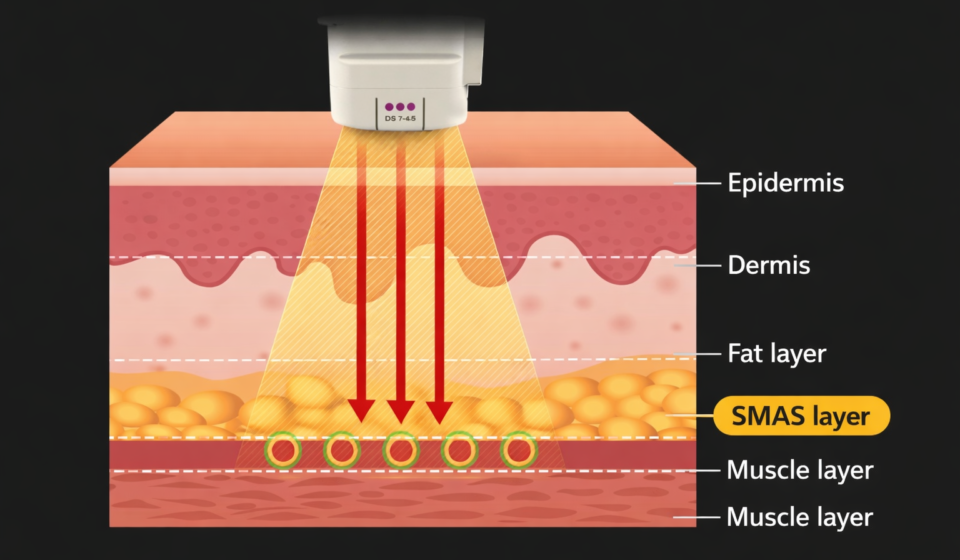
HIFU delivers energy deeper than RF, reaching the SMAS layer (4.5 mm). This is the same layer targeted during clinical lifting procedures. That’s why it shows clear effectiveness in improving cheek sagging, defining the jawline, and enhancing facial contours.
However, because HIFU is quite strong, there is something I always emphasize: “Overusing HIFU will inevitably cause side effects.” Devices such as Infinity, Lukins, Homsera, and Nuzmi are typical examples of HIFU‑based products.

⚡ EMS (Microcurrent) — A lifting method that directly stimulates the muscles
The next commonly used option is EMS, or microcurrent devices. Unlike RF or HIFU, which stimulate deeper layers of the skin, EMS works by directly stimulating the facial muscles to create a lifting effect.
That’s why many people feel an immediate improvement in facial contours, reduced puffiness, and a more defined jawline after using EMS. It also boosts blood circulation, giving the face a more refreshed and lively appearance. Devices like NuFace and Foreo Bear are well‑known examples.
People who tend to experience facial swelling in the morning often see faster results from EMS.
However, there’s a reason you shouldn’t use EMS every day. Facial muscles are just like the muscles in your body—if you overwork them, they become fatigued, tight, and sore. Excessive stimulation can cause stiffness, discomfort, and even skin sensitivity due to the current. That’s why using EMS 3–4 times a week or every other day is the safest and most effective approach.

💡 LED — Generally safe, but harmful when overused
LED devices are relatively safer than the other technologies mentioned earlier. Red LED helps with elasticity and collagen, while blue LED is effective for managing breakouts and sebum. That’s why it’s a great option for beginners starting home skincare.
LED devices do not directly irritate the skin barrier, making them relatively comfortable even for sensitive skin.
However, using LED devices for long periods every day can also cause problems. Excessive light exposure may lead to dryness, warmth, redness, and increased sensitivity. Many people even feel their skin becomes more reactive when they use LED masks for too long. That’s why once a day for about 10–15 minutes is the most appropriate usage.
🔍 Why shouldn’t home lifting devices be used every day?
This is something I always emphasize to my patients.
“Skin improves only when it goes through the cycle of stimulation → recovery → improvement.”
A device is ultimately a tool that gives the skin stimulation. But if you keep giving stimulation without allowing recovery…
- inflammation increases, and…
- collagen breaks down, and…
- elasticity decreases, and…
- in the long run, aging can accelerate.
Home-care devices are indeed designed to be weaker than clinical equipment, but that absolutely doesn’t mean they can be used every day. In fact, using a weaker device daily can sometimes be even riskier because the skin loses the time it needs to recover.
Home lifting devices can definitely be helpful when used correctly. However, like any technology, the skin improves only when stimulation and recovery are balanced. If you ignore proper usage frequency, you may experience side effects such as reduced elasticity or increased sensitivity. Home-care devices are safest and most effective when used as a supplementary method rather than a complete replacement for clinical treatments. What matters most is using them consistently and accurately within the limits your skin can handle.

❓ F&A (FAQ)
1) Can home lifting devices alone achieve the same results as clinical treatments?
→ The principle is similar, but because the intensity and depth are different, achieving the exact same results is difficult.
2) Which is more effective, radiofrequency or HIFU?
→ They serve different purposes.
Radiofrequency is better suited for improving elasticity and skin texture, while HIFU is more effective for contouring and lifting sagging areas.
3) Why is it not recommended to use home-care devices every day?
→ When stimulation accumulates without recovery, it can lead to decreased elasticity, redness, swelling, and inflammation.
4) Can EMS devices be used every day?
→ It can cause muscle fatigue and increased skin sensitivity, so using it every other day or about 3–4 times a week is appropriate.
5) Are LED masks safe?
→ It is relatively safe, but excessive light exposure can cause dryness and redness, so 10–15 minutes is the appropriate duration.
Made Young Plastic Surgery Clinic Website https://www.made-young.com
Discover more from Korea Doctor Interview
Subscribe to get the latest posts sent to your email.