Professional Guide to Implant Bone Grafting — Causes of Jawbone Loss After Tooth Loss and Key Treatment Strategies

Teeth do more than simply chew food — they play a crucial role in maintaining facial structure, pronunciation, and expression.
However, when a tooth is lost, it doesn’t end with simply “missing one tooth.” The surrounding jawbone begins to resorb rapidly, leading to even bigger problems. Many people think, “Isn’t it just the tooth that’s gone?” but in reality, a chain reaction occurs: bone loss → collapse of dental alignment → changes in facial structure → increased difficulty of implant treatment.
Through an interview with Director Ryu Seong-hoon of Korea Balance Dental Hospital, we explored in depth why the jawbone deteriorates after tooth loss, why bone grafting is essential for implants, and the differences between placing an implant immediately after extraction versus waiting.

Why does the jawbone rapidly deteriorate when a tooth is lost?
Director Ryu Seong-hoon explained that “there are two main reasons why teeth are lost.”
The first reason is when dental caries progress all the way to the root, and the second is when periodontal disease gradually causes the jawbone to deteriorate. When tartar and inflammation persist for a long time, the supporting bone weakens, the tooth becomes loose, and extraction eventually becomes necessary.
When a tooth is extracted due to severe decay, the surrounding bone is usually relatively healthy. However, when a tooth is removed because of periodontal disease, the jawbone has already been significantly lost.
The problem is that once a tooth is lost, the surrounding bone loses its function and is rapidly resorbed. In fact, “within just three months, about 50% of the jawbone can disappear.”
This is similar to how an arm in a cast becomes thinner because the muscles are not being used. When a structure is not functioning, both muscles and bone naturally decrease.
The alveolar bone also loses its function once a tooth is gone and is rapidly resorbed.
Problems that arise when tooth loss is left untreated
If tooth loss is left untreated for a long time, it becomes far more than just “missing one tooth.” Over time, a series of problems begin to occur.
- Adjacent teeth tilt into the empty space, causing collapse of the dental arch
- The opposing tooth moves downward or upward into the empty space, causing occlusal imbalance
- Reduced chewing ability leads to digestive problems
- Changes in pronunciation and air leakage while speaking
- Changes in facial contours (deepening of nasolabial folds, sunken areas around the mouth)
- The implant placement space becomes narrower, increasing the difficulty of the surgery
- Bone loss in the jaw increases the cost of bone grafting
In other words, tooth loss leads to progressively worsening problems over time, so it is important to establish a treatment plan as early as possible.
So, why is bone grafting for implants important?
Many patients wonder, “Do I really need a bone graft when getting an implant?”
Although the cost can be significant, Director Ryu Seong‑hoon emphasizes that “bone grafting is the key to implant success.”

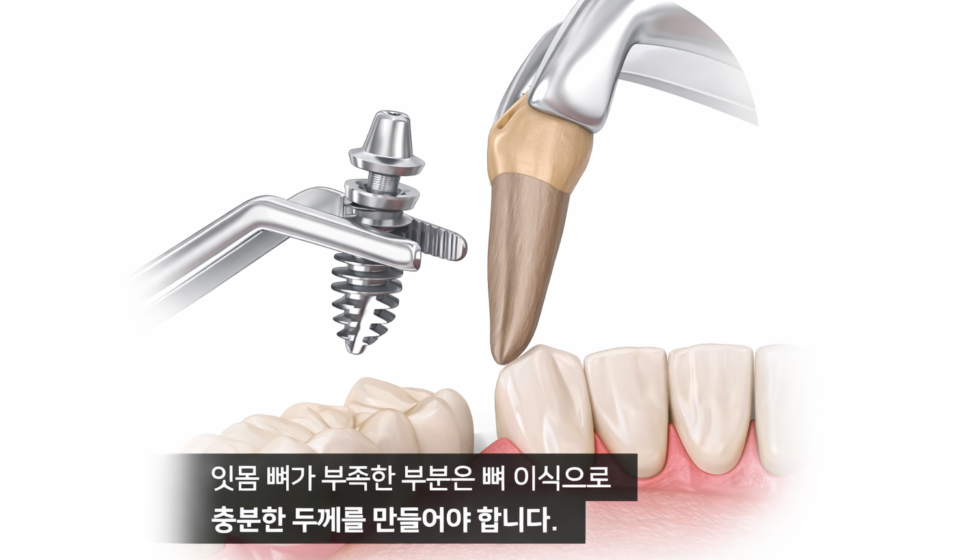
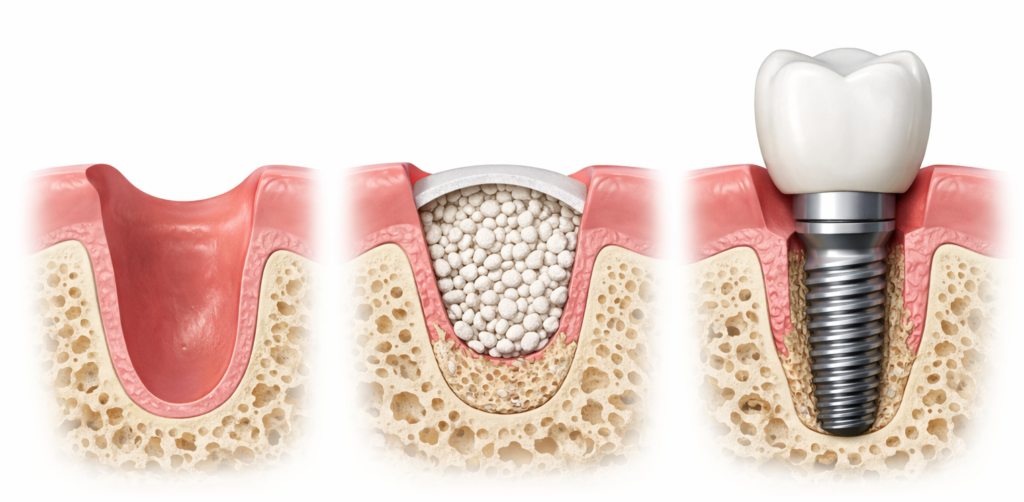
An implant is structured to be anchored into the jawbone like a screw. Therefore, the bone must be strong for the implant to stabilize properly, allowing a prosthesis to be placed on top so even hard foods can be chewed without difficulty. “The stability of an implant is like driving a nail into a wall.”
A nail holds firmly in a solid concrete wall, but it comes out easily from a weak one. Likewise, if the jawbone is weak, the implant’s stability decreases and its lifespan becomes shorter.
Therefore, if the jawbone is insufficient or the bone quality is weak, a bone graft is essential to create a strong foundation.
How do we choose the right bone graft material?
The selection of bone graft materials is determined by the specialist.
Bone graft materials are not chosen by the patient; they are determined by the specialist after a precise evaluation of the jawbone condition.
The criteria for selecting bone graft materials are as follows.
- The current amount and thickness of the jawbone
- Bone quality (density and hardness)
- Resorption rate and structural stability
- The required amount of bone
- The extent of the surgical area and the expected healing speed
- The patient’s overall systemic health condition
In other words, it’s not about simply saying “this material is better,” but about the specialist determining and selecting the most suitable combination of materials for each patient. Main types of bone graft materials used
1. Autogenous bone (patient’s own bone)
Using the patient’s own bone provides the highest success and integration rate. However, because bone harvesting is required, the surgical area may become larger.
2. Allogeneic bone (donor human bone)
It is a processed material derived from human donor bone, offering stability and widespread clinical use.
3. Xenogeneic bone (animal-derived bone)
It is a bone graft material derived from bovine or porcine sources, known for its excellent shape retention and frequent clinical use.
4. Synthetic bone graft (artificial bone substitute)
It is a synthetic material with high safety and adjustable resorption rates.
In most cases, two or more materials are combined, and the choice varies depending on the specialist’s experience and the patient’s condition.
Cases where the implant is placed immediately after extraction and cases where healing time is allowed before placement
In the past, it was common to wait at least 3 to 4 months after extraction before placing an implant.
However, with advancements in techniques and materials, immediate implant placement has now become possible.
“If the bone is firm and of good quality after extraction, an implant can be placed immediately.”
The primary stability of an implant can be mechanically measured during surgery, and an ideal value is around 35 N·cm.
When this level is achieved, immediate placement is possible and stable outcomes can be expected.
Immediate implant placement shortens the treatment period and reduces patient discomfort, but it is only possible when the bone condition is sufficiently strong.
“Tooth loss is not simply the loss of a single tooth; it is a complex process that leads to gum bone resorption → collapse of dental alignment → facial changes → increased implant difficulty. Therefore, if a tooth is lost, it is important to establish a treatment plan as early as possible.”
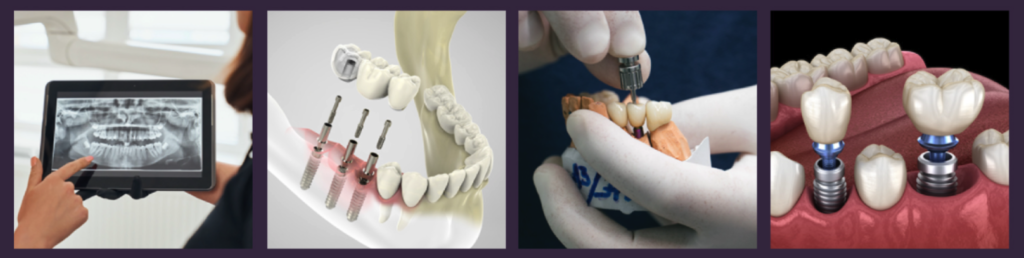
(Implant placement procedure)
“In implant treatment, bone grafting is not optional but an essential step for success.
The choice of graft material is not made by the patient; rather, the specialist determines it by thoroughly analyzing the condition of the jawbone and selecting the most appropriate combination of materials.
This professional judgment directly influences the longevity and stability of the implant.”
The information presented in this article is based on the real clinical experience and explanations of Dr. Ryu Seong-hoon of Korea Balance Dental Hospital.
If you are considering treatment for tooth loss or dental implants, we hope his insights help you better understand your oral condition and guide you toward a safer and more accurate treatment plan.
Korea Balance Dental Hospital website https://www.balancedental.co.kr
Discover more from Korea Doctor Interview
Subscribe to get the latest posts sent to your email.