Why Contracted Nose Occurs and How to Correct It | From Capsular Contracture Mechanism to Reconstructive Surgery

Rhinoplasty is a procedure many people choose to improve facial balance and enhance their overall appearance.
However, unexpected changes can appear over time, and among them, the complication patients fear the most is contracted nose.
This article is based on an interview with the director of Homme & Femme Plastic Surgery, a specialist in rhinoplasty, revision surgery, and reconstruction, and explains why contracted nose occurs, how it progresses, and how it can be corrected, focusing on real patient cases.
✔ Why does contracted nose occur?
Most people undergo rhinoplasty to raise a low nasal bridge. To achieve this, implants such as silicone or Gore-Tex are inserted, but from the body’s perspective, these implants are foreign materials.
The body forms a capsule to separate this foreign material… creating a thin membrane called a capsule
A normal capsule is very thin and soft, so it does not cause any problems.

But when inflammation occurs or the foreign-body reaction becomes stronger, the capsule begins to thicken. This thickened capsule creates a pulling force on the nose, and this is the beginning of contracture.
✔ What happens when the capsule becomes thicker?
When the capsule thickens, it creates a pulling force similar to a stretched rubber band, lifting the nose upward or pulling the columella inward. This phenomenon is called capsular contracture, commonly known as a contracted nose.
In patients with severe contracture, the silicone implant that was originally L‑shaped can sometimes appear bent. This is the result of the capsule pulling the implant in an abnormal direction. If the implant bends to that extent, it is natural for the entire shape of the nose to become deformed.
✔ How a contracted nose becomes deformed
Contracture does not simply cause the nose to lift,
- the columella may collapse or
- or the columella may droop downward
- the tip of the nose may become stiff or
- the nose may twist or
it can appear in various forms.
Therefore, the appearance of a contracted nose varies from patient to patient, and the correction method also differs accordingly.
(Case 1 – actual patient)
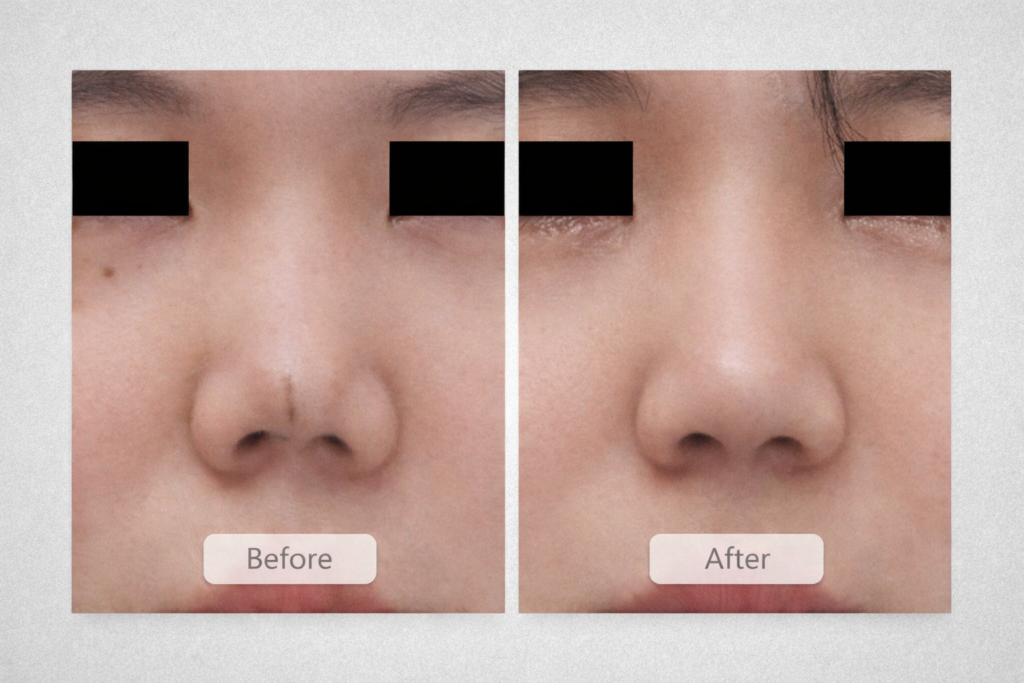
✔ Case 1 — a contracted nose with the columella pulled inward
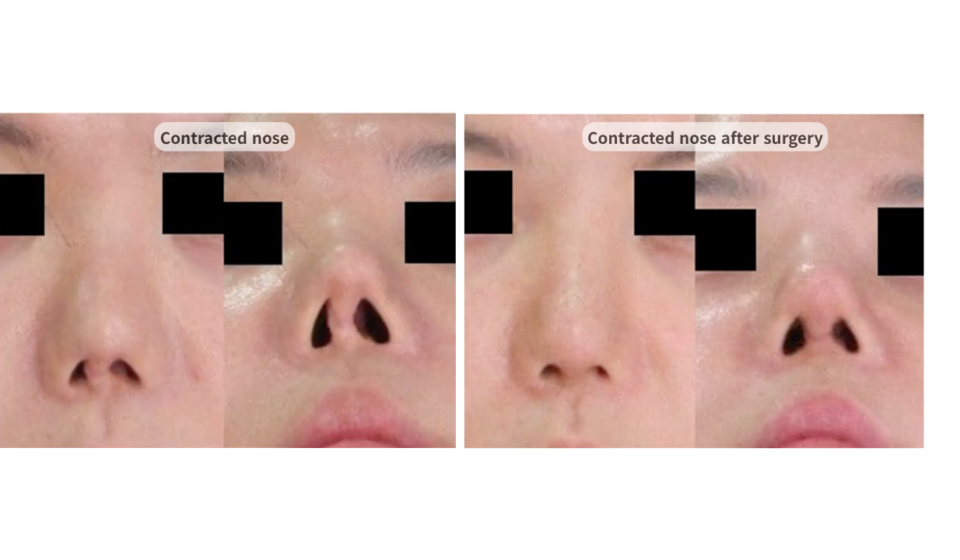
In the patient shown above, the capsule pulled the columella strongly upward, causing it to sink inward. From both the front and the underside, the columella appeared similarly rolled inward, which is a typical presentation of a contracted nose.
The most important step in correcting this type of contracted nose is to completely remove the implant and the surrounding capsule.
If the capsule remains, it will eventually create a pulling force again over time, causing the nose to lift even more.
✔ Structural reconstruction is required after capsule removal
After removing the capsule in a contracted nose, it is necessary to reestablish and stabilize the nasal structure.
At Homme & Femme Plastic Surgery, the Diamond Tip Correction technique is used at this stage.
This method
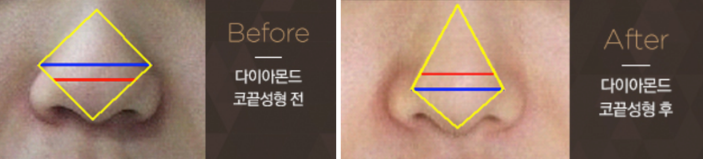
- without inserting an implant
- lowering the position of the nasal tip cartilage
- It is a method that creates a natural nasal shape.
It is especially effective for patients whose nasal tip cartilage is well preserved, and because no implant is used, it also has the advantage of reducing the risk of contracture recurrence.

(Case 2 – actual patient)
✔ Case 2 — when the cartilage has dissolved
Another patient in the photo had not only capsular contracture but also columellar cartilage that had dissolved due to inflammation. In this case, because the nasal tip cartilage had disappeared, reconstructive surgery using ear cartilage was required to rebuild the nasal tip.
In other words,
- Contracted nose with remaining cartilage → can be corrected without additional cartilage
- Contracted nose with dissolved cartilage → requires reconstruction using ear cartilage, etc.
Because the surgical method varies depending on the condition, an accurate diagnosis is extremely important.
✔ Contracted nose: “When should revision surgery be done?”
This is the question that patients with contracted nose ask the most.
“My nose looks lifted due to contracture — do I need revision surgery right away?”
Contracture is progressive. As time passes, the nose becomes more upturned. The earlier it is corrected, the lower the surgical difficulty and the more stable the results.
At first, you may not notice it yourself. Because you see your face every day, the change is hard to feel, but the moment someone you haven’t seen in a while says, “Why does your nose look lifted?”, the contracture is already progressing.
✔ The longer a contracted nose is left untreated, the more difficult it becomes.
A contracted nose does not occur suddenly; it progresses gradually. Even if it looks fine now, there is a high possibility that it will become more upturned after 3, 4, or 5 years.
Therefore, if contracture is certain, it is best to undergo revision rhinoplasty as soon as possible. Although daily activities may be uncomfortable for at least a week after surgery, it is important to remember that delaying it makes the procedure more difficult and the deformity more severe. I hope what I’ve shared is helpful for those considering revision surgery for a contracted nose.
Homme & Femme Plastic Surgery YouTube Channel https://www.youtube.com/channel/UCfOt6lAgcIpllkMgqvs-W0g

📌 F&A (Frequently Asked Questions)
1. Why does a contracted nose occur?
This occurs because the capsule around the implant thickens due to inflammation or a foreign‑body reaction, creating a pulling force on the nose.
2. Does a contracted nose improve naturally over time?
No. Contracture is progressive, so it worsens as time goes by.
3. When is the best time to undergo revision surgery for a contracted nose?
The sooner, the better. The longer you wait, the harder the correction becomes and the more severe the deformity can get.
4. 구축코 교정 시 보형물을 꼭 빼야 하나요?
대부분의 경우 피막과 보형물을 함께 제거해야 재발을 막을 수 있습니다.
5. 연골이 녹아버린 경우에도 교정이 가능한가요?
가능합니다. 이 경우 귀 연골 등으로 재건이 필요합니다.
Discover more from Korea Doctor Interview
Subscribe to get the latest posts sent to your email.