

Core Principles of Korean Facelift Ponytail Lift Surgery and the Importance of the Mini Three Procedures

Korean facelift surgery has evolved beyond traditional methods that simply pull the skin, advancing toward techniques that address deeper structural issues of the face. In particular, the ponytail lift emphasized by Dr. Hyun‑Chul Kim of Kidari Plastic Surgery in Gangnam has gained significant attention as a new concept that maximizes rejuvenation effects by improving midface sagging, drooping mouth corners, and loss of anterior cheek volume—problems that conventional facelifts cannot fully resolve.
In this article, based on Dr. Hyun‑Chul Kim’s actual explanations and answers, we will explore in depth the concept of the ponytail lift, the limitations of conventional facelift surgery, and why the mini three procedures are essential for achieving a youthful appearance.
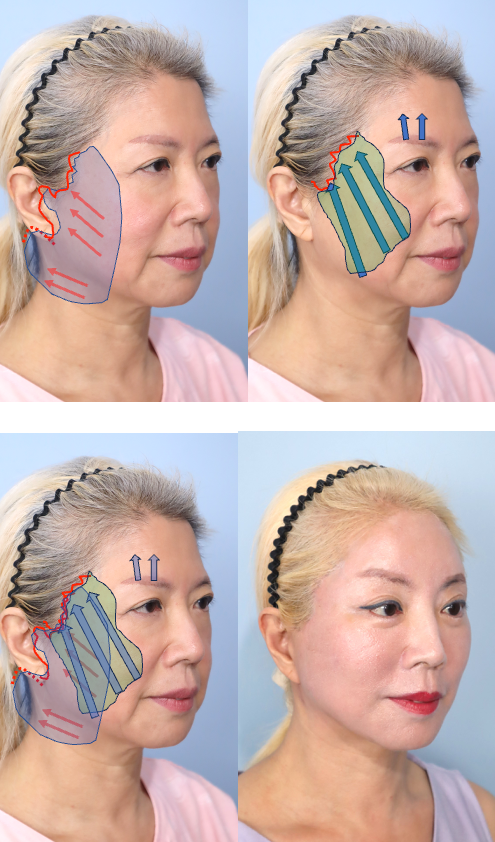
What is the ponytail lift? Although “ponytail” literally means the tail of a small horse, it is easier to understand when you imagine the familiar hairstyle. When you tie your hair into a single bundle at the back of your head, the forehead and temples are naturally pulled upward, lifting the eyebrows and giving the entire face a more youthful appearance. Applying this natural “upward‑pull vector” to plastic surgery is what defines the ponytail lift. Rather than simply pulling the skin, the ponytail lift elevates the central facial structures upward to create a youthful look. While traditional facelifts rely heavily on lateral pulling forces, the ponytail lift uses an upward vector to achieve a more natural and younger‑looking result.
Limitations of Traditional Facelift Surgery
Traditional facelift surgery begins with an incision in front of the ear, extending into the ear canal and behind the neck, after which the SMAS layer is pulled laterally and fixed in place.
This method is effective for improving jawline definition and neck sagging, but it has the following limitations.
- Crow’s feet, Indian folds, and nasolabial folds do not fully smooth out
- A droopy or downturned look around the mouth remains
- The anterior cheek volume does not recover
- The central part of the face remains sagging, and only the sides are pulled, resulting in an unnatural appearance
- Lack of a natural rejuvenating effect
In other words, the biggest problem with traditional facelift surgery is that it fails to address the front and central areas of the face.
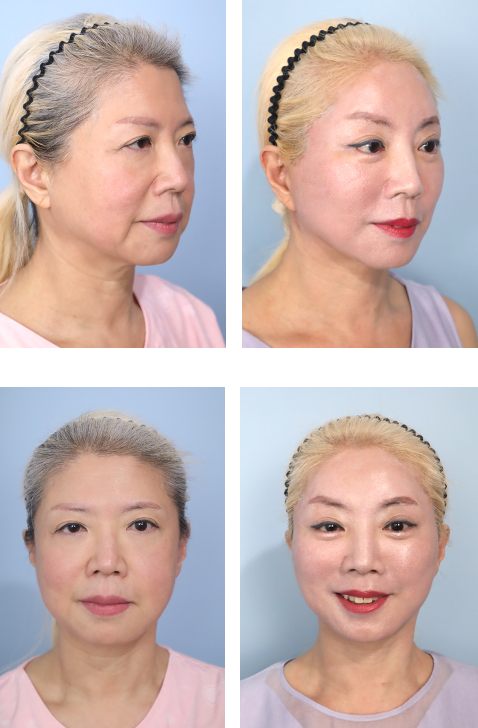
This is why many patients who are not satisfied after receiving only a traditional facelift come to Kidari Plastic Surgery for revision surgery.
Core of the Korean Facelift: The Mini Three Procedures (Key Components of the Ponytail Lift)
Kidari Plastic Surgery refers to the ponytail lift as the “Mini Three Procedures,” emphasizing that the true ponytail lift effect is achieved only when the following three surgeries are combined.
1. Sub‑brow Lift
Lifting the skin and muscle directly beneath the eyebrow
- Improvement of sagging around the eyes
- Reduction of crow’s feet wrinkles
- Creating a refreshed and youthful eye shape
A sub‑brow lift is not simply pulling the area around the eyes; it is a key rejuvenation procedure that addresses the structural sagging of the eye region.
2. Temporal Mini Lift (Subperiosteal Lift)
Starting from the temporal region, dissecting the deep layer beneath the cheekbone and toward the front of the masseter muscle
- Lifting the central area of the face upward
- The front‑cheek volume is naturally restored
- Lifting of the mouth corners
- Improvement of nasolabial folds (Indian lines)
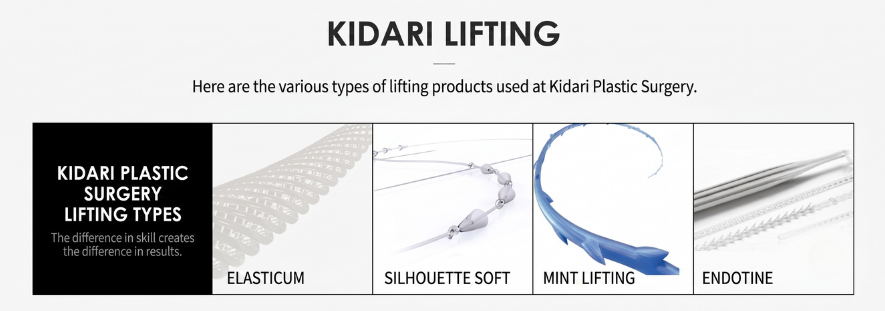
The key is lifting the deep tissues beneath the bone through subperiosteal dissection, and securing them firmly using Endotine (a dissolvable hook).
This procedure creates a naturally youthful effect that cannot be achieved with traditional facelift techniques.
3. Midface Lift
By addressing midface issues such as nasolabial folds, sagging of the front cheek, and hollowing beneath the cheekbone
- Creating the front‑cheek prominence, the key element of a youthful face
- Natural volume restoration and elevation of the mouth corners
- Achieving a bright and lively facial impression
A midface lift is a procedure that directly improves the central area of the face and is one of the most important elements in creating a youthful appearance.
Why must these three procedures be performed together?
Director Kim Hyun‑cheol says, “If you perform only a facelift without these three procedures, the central part of the face remains sagging and only the sides are pulled, resulting in an unnatural look.”
In other words, the key to a youthful face lies in the front and central areas, but traditional facelifts do not address these regions.
This leads to the following problems.
- Nasolabial folds do not fully smooth out
- Indian lines (mid‑cheek grooves) remain
- The corners of the mouth do not lift
- The anterior cheek volume does not recover
- An overall result that looks “lifted, but not pretty.”
Ultimately, a facelift performed without the three mini‑procedures for a youthful appearance inevitably has a higher likelihood of requiring revision surgery.
How is Kidari Plastic Surgery’s Korean‑style facelift different?
At Kidari Plastic Surgery, the full facelift is performed in the following way.
- Lifting the deep tissues upward through subperiosteal dissection
- Secure fixation using Endotine
- Enhancing lateral lifting with a traditional SMAS facelift
- Sub‑brow lift + lower blepharoplasty + aegyosal creation
- Including a neck lift that tightens all the way to the front of the neck
In other words, it can be described as a “full‑package anti‑aging facelift” that combines all the necessary elements at once.
Important points to remember when considering a Korean‑style facelift
- A facelift that pulls only sideways has inherent limitations.
- A youthful effect is achieved only when the central part of the face is lifted upward.
- The ponytail lift (the three mini anti‑aging procedures) improves the key structural elements of a youthful face.
- To avoid revision surgery, a subperiosteal lift that elevates the deep layers from the start is essential.
Korean‑style facelift techniques have evolved beyond simply pulling the skin, moving toward correcting structural sagging from the deeper layers of the face. The ponytail lift is the most essential method for maximizing youthful results, and Kidari Plastic Surgery’s three mini anti‑aging procedures fundamentally improve issues that traditional facelifts cannot resolve.
If you want a youthful-looking face, choosing a ponytail lift—which elevates the central facial structures upward—rather than a facelift that only pulls sideways, is the key to achieving far more natural and satisfying results.
Kidari Plastic Surgery Official Website
👉 View detailed information about Kidari Plastic Surgery:
Discover more from Korea Doctor Interview
Subscribe to get the latest posts sent to your email.



Leave a Reply
You must be logged in to post a comment.
-
-
-
-
-
-
-
-
-
-
-
-
Show Comments[…] 한국거상수술 포니테일 거상수술의 핵심 원리와 동안 미니 3종의 중요성 […]
[…] 한국거상수술 포니테일 거상수술의 핵심 원리와 동안 미니 3종의 중요성 […]
[…] 한국거상수술 포니테일 거상수술의 핵심 원리와 동안 미니 3종의 중요성 投稿者 […]
[…] 한국거상수술 포니테일 거상수술의 핵심 원리와 동안 미니 3종의 중요성 […]
[…] 한국거상수술 포니테일 거상수술의 핵심 원리와 동안 미니 3종의 중요성 […]
[…] 한국거상수술 포니테일 거상수술의 핵심 원리와 동안 미니 3종의 중요성 […]
[…] 한국거상수술 포니테일 거상수술의 핵심 원리와 동안 미니 3종의 중요성 […]
[…] 한국거상수술 포니테일 거상수술의 핵심 원리와 동안 미니 3종의 중요성 […]
[…] 한국거상수술 포니테일 거상수술의 핵심 원리와 동안 미니 3종의 중요성 […]
[…] 한국거상수술 포니테일 거상수술의 핵심 원리와 동안 미니 3종의 중요성 […]
[…] 한국거상수술 포니테일 거상수술의 핵심 원리와 동안 미니 3종의 중요성 […]
[…] 한국거상수술 포니테일 거상수술의 핵심 원리와 동안 미니 3종의 중요성 […]