
Fail-Proof Bulbous Nose Revision Surgery Explained by Dr. Hwang Kyuseok — 28 Years of Expertise

Bulbous Nose Surgery for 28 Years — Dr. Hwang Kyuseok Shares the Real Story Behind Bulbous Nose Correction
We interviewed Dr. Hwang Kyuseok of Homme & Femme Plastic Surgery, who has specialized in bulbous nose surgery for 28 years, to discuss how people struggling with a bulbous nose can find a reliable and definitive solution.
I hope this article provides clear guidance and valuable information for those struggling with a bulbous nose.

Hwang Kyuseok explains that
He said, “I also have a bulbous nose, so I understand better than anyone how patients with this concern feel.”
A bulbous nose is not stressful simply because it is large. It often stands out first in photos, disrupts the overall balance of the face, and even after surgery, many people remain dissatisfied with the results.
Bulbous noses are the type with the highest dissatisfaction after surgery. The reason is clear — bulbous nose correction is one of the most challenging procedures.
Why is the failure rate of bulbous nose surgery so high?
Structurally, a bulbous nose
- the cartilage is large and
- the skin is thick and
- there is a thick layer of fat and
- in most cases, the overall volume itself is quite large.
However, many clinics try to correct a bulbous nose by inserting implants, support structures, or additional cartilage inside the nose.
“If you put something inside the nose, it gets bigger — it never becomes smaller.”
A bulbous nose already has substantial volume, and adding more material on top of that may make it look higher on the outside, but in reality, it becomes even larger and more blunt. This is the biggest reason why bulbous nose surgery often fails.
Key Principle of Bulbous Nose Revision Surgery: “Don’t add — remove.”
- Remove all previously inserted implants.
- Do not insert anything.
- Perform the surgery with the goal of reducing volume.
A bulbous nose is not something that can be corrected by adding material. The more you add, the larger, blunter, and less satisfying the result becomes.
Therefore, the first step in bulbous nose revision surgery must be removal.

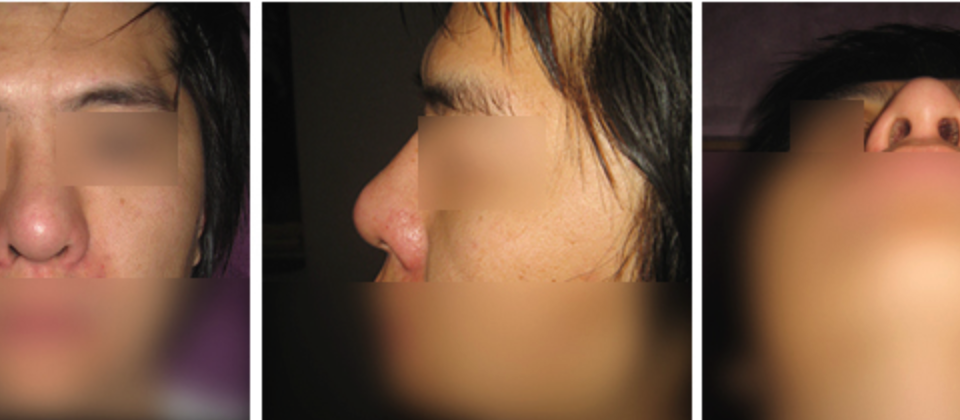
Case Study: A Bulbous Nose Unresolved Even After Four Surgeries
The patient shown above
• Implant
• Support graft / Strut
• Cartilage and other materials had been inserted repeatedly, causing the nose to become progressively larger and more blunt.
Dr. Hwang removed all the inserted materials and performed the revision surgery by reducing the volume. As a result, the size of the nose decreased to about one‑third of its original size.


This case is a representative example showing why a bulbous nose can never be corrected by “adding more material.”
The Real Principle Behind Reducing a Bulbous Nose
• Removal of implants
• Technique for consolidating (gathering) the cartilage
• Adjustment of skin and soft‑tissue thickness
• A surgical philosophy focused on reducing overall volume
Many clinics insert a strut to raise the nasal tip, but
“Ultimately, a strut is still something you place inside the nose. Adding it increases the volume.”
The Importance of Alar Reduction
A bulbous nose is not only about a large nasal tip. In many cases, the wide alar base makes the nose appear bigger. In such situations, alar reduction plays a very important role.
Even by reducing only the alar base,
• The entire nose appears smaller
• Facial proportions improve
• The bulbous appearance is significantly reduced
“Alar reduction is an essential component that cannot be omitted in bulbous‑nose revision surgery.”
World’s First External Incision Technique (2008) — A Fundamental Method for Correcting a Large Nose
People who fundamentally have a large nose
• The cartilage is large
• The skin is thick
• There is often an excess of soft tissue
In this case, simply narrowing or gathering the tissues has its limitations.
In 2008, Director Hwang developed the world’s first external incision technique. This procedure literally removes a portion of the skin to directly reduce the size of the nose.
In 2013, this procedure was presented at a conference in San Diego, USA, and gained international recognition. Although scarring can occur, it remains the only method capable of fundamentally correcting an overly large nose.
Why a Bulbous Nose Becomes Enlarged Again: Scar Tissue (Fibrosis)
Many patients say this: “After my bulbous‑nose surgery, it became big again over time.”
The reason is scar tissue (fibrosis). When scar tissue forms during the healing process after surgery, the nose can become thicker and appear enlarged again.
Homme & Femme Scar‑Recurrence Prevention Program
Homme & Femme Plastic Surgery operates a continuous 2–3 month management program to prevent scar tissue formation after bulbous‑nose surgery. Through this program,
- A nose reduced by 50%
- We minimize scar‑tissue recurrence so that the results remain at about 55–60% even over time.
The key is to prevent the nose from enlarging again to 70–80%, as often happens at other clinics.
Revision Bulbous‑Nose Surgery Perfected Through 28 Years of Expertise
Based on 28 years of exclusively performing nose surgeries, Director Hwang has perfected the technique of creating a beautiful nose without adding implants or fillers. The fundamental principles of revision surgery for a bulbous nose are as follows.
• Removal of implants
• Minimize volume
• Structural narrowing
• Alar reduction
• External incision when necessary
• Scar‑recurrence prevention program
Through all these steps, we fundamentally reduce the bulbous nose and maintain the results so it does not enlarge again.
For those struggling with a bulbous nose
Since I also have a bulbous nose, I understand better than anyone how my patients feel. A bulbous nose cannot be fixed by simply adding materials. It must be properly reduced and refined.
If you are considering primary or revision surgery for a bulbous nose, the most important factors are an experienced specialist’s accurate diagnosis and surgical philosophy.
❓ F&A
1. Why is bulbous‑nose surgery prone to a high failure rate?
Because the nose already has excessive volume, yet many procedures add implants or support materials on top of it.
2. What is the key to revision surgery for a bulbous nose?
It involves removing the existing implants and reducing the volume without adding any new materials.
3. When is an external incision approach necessary?
It is necessary when the nose is fundamentally large and the skin and cartilage are thick.
4. Why does the nose become enlarged again after surgery?
It is due to scar tissue (fibrosis), and postoperative care to prevent scar recurrence—such as a scar‑recurrence prevention program—is extremely important.
5. Is alar (nostril) reduction always necessary?
In cases of a bulbous nose with wide alar bases, alar reduction alone can significantly make the nose appear smaller.
6. Will removing the implant ruin the shape of my nose?
With the right surgical expertise, a beautiful shape can be achieved even without adding any implants.
7. Is revision surgery for a bulbous nose more difficult than the first operation?
It is usually more difficult because it requires removing the previous implants and managing scar tissue.
8. Is the scar from an external incision very noticeable?
Although it varies by individual, in many cases the benefits are significant enough to outweigh the concern.
9. Why is postoperative care important after bulbous‑nose surgery?
Since scar tissue can cause the nose to enlarge again, consistent care for 2–3 months is essential.
10. How much smaller can the nose become with revision surgery for a bulbous nose?
Although it varies by case, many patients experience a reduction of more than 30–50%.
옴므앤팜므성형외과 youtube www.youtube.com/@user-drhwang
Homme & Femme Plastic Surgery Clinic Website http://www.dr4nose.com
Discover more from Korea Doctor Interview
Subscribe to get the latest posts sent to your email.


Leave a Reply
You must be logged in to post a comment.
[…] 복코재수술 28년 황규석 원장이 말하는 실패 없는 복코성형 […]