


Hair loss in its early stages may feel sudden to anyone, but in reality it often progresses very slowly.
Early-stage hair loss is especially hard to recognize on your own, making it easy to miss the right time for treatment.
For this reason, we asked Dr. Jin‑O Kim of New Hair Clinic in Gangnam for his professional insights on accurate early-stage hair loss diagnosis and proper management methods.

(Dr. Jin‑O Kim, New Hair Hair Transplant Clinic)
———————————————
The term “early-stage hair loss” is actually quite ambiguous. That’s why proper testing is necessary for an accurate assessment. Through microscopic examination, you can objectively determine the stage of hair loss by checking changes in hair thickness, the ratio of miniaturized hairs, and the pattern of shedding. However, if you feel that your hair volume has decreased compared to before or your hairstyle no longer sets naturally as it used to, it is reasonable to consider that you may already be in the early stage of hair loss.
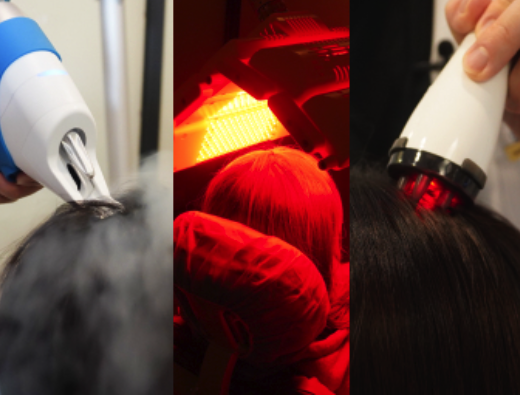
Frontal hair loss is particularly noticeable because the changes are easy to see. In the past, the bangs may have come down as a single thick section, but as hair loss progresses, the bangs begin to split and fall into thin strands. In contrast, crown hair loss is harder to notice on your own, so many people discover it much later. Recently, with more selfies and video recordings, more individuals are visiting clinics after accidentally seeing their crown captured in photos or videos.
In female‑pattern hair loss, the most typical sign is the “Christmas tree pattern,” where the part gradually widens. If people around you start saying that your crown looks empty, it usually means that more than 20–30% of hair loss has already progressed. Medically, the early stage is defined when the hair becomes thinner or the scalp starts to show through, but in reality, if you notice it yourself or others point it out, it is often already beyond the very early stage and closer to the early‑to‑mid stage of hair loss.

(Female‑pattern hair loss progression / Christmas tree pattern image)
If you have a family history of hair loss or experience periods of excessive shedding, it’s best not to ignore it and get examined at a clinic. I especially emphasize the importance of regular check‑ups. Visiting the clinic every 6 to 12 months to check hair thickness, density, and the speed of progression allows you to objectively understand how far the hair loss has advanced. Additionally, taking monthly photos of your crown and hairline under consistent lighting and from the same angle is also a very effective method for comparison.
Crown hair loss generally responds well to treatment. The younger the onset and the sooner treatment begins after symptoms appear, the better the results tend to be. Since the crown area responds more effectively to medication and clinical procedures than the frontal hairline, early treatment can lead to significant improvement.
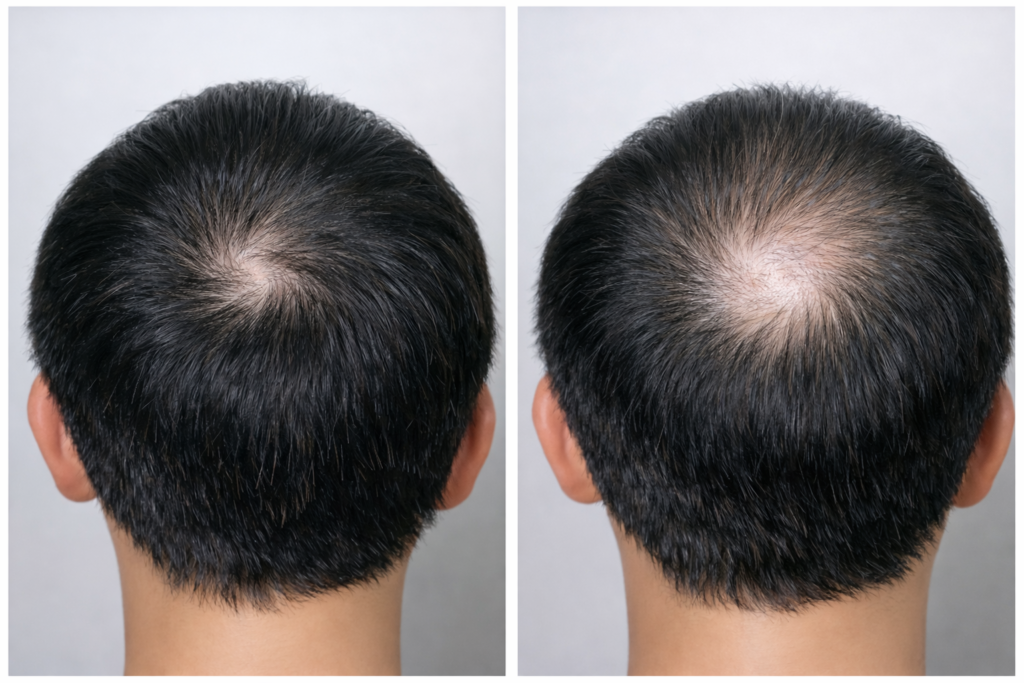
(Crown hair loss early and mid‑stage progression image)
Early and accurate diagnosis and monitoring significantly improve the effectiveness of hair loss treatment. It is crucial not to overlook the subtle period when changes feel unclear, and instead confirm your condition objectively through regular check‑ups and documentation. Professional evaluation and systematic management are key to slowing the progression of hair loss and maximizing improvement.
📌FAQ — Frequently Asked Questions About Early‑Stage Hair Loss
Q1. Is there a way to check at home if I’m in the early stage of hair loss?
A. The most accurate method is to take monthly photos of your crown and hairline under consistent lighting and from the same angle. If the part becomes wider or the scalp becomes more visible, the likelihood of early‑stage hair loss is high.
Q2. If people around me say my crown looks “empty,” how far has the hair loss progressed?
A. Hair loss typically becomes noticeable to others when density has decreased by 20–30% or more. At that point, it is likely beyond the very early stage and closer to the early‑to‑mid stage.
Q3. Between crown hair loss and frontal hairline hair loss, which area responds better to treatment?
A. Crown hair loss generally responds better to treatment. The speed and degree of improvement from medication and procedures often appear faster than in the frontal hairline.
Q4. How often should I get checked for hair loss?
A. A regular check‑up every 6 to 12 months is recommended. This allows you to objectively assess hair thickness, density, and the rate of hair loss progression.
Q5. If I’m in the early stage of hair loss, do I need to start treatment right away?
A. Since treatment is more effective in the early stages, it is best to begin as soon as possible. This is especially important if you have a family history of hair loss or notice an increase in shedding.
New Hair Hair Transplant Clinic Website https://newhairps.com
Discover more from Korea Doctor Interview
Subscribe to get the latest posts sent to your email.


