
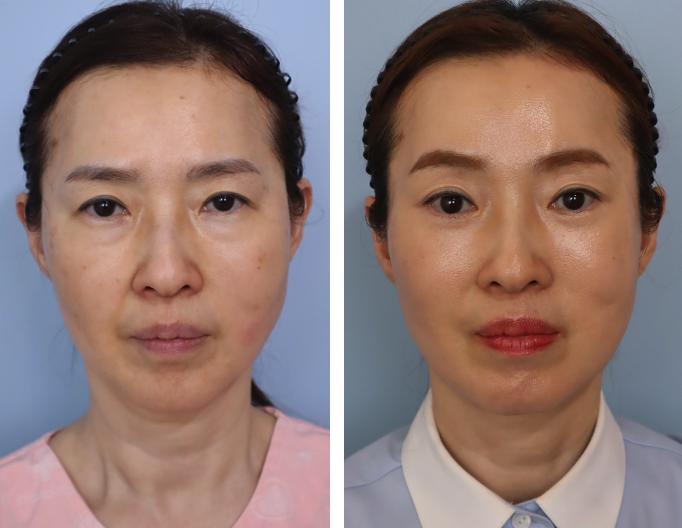

✨ The real meaning behind the short duration of mini facelift results — expert explanation
Mini facelift surgery has recently become a lifting procedure that many people are increasingly interested in,
Especially, the question “Is the mini facelift duration short?” is one of the most frequently asked concerns among people considering a full facelift.
Mini facelift surgery has the advantage of being simple and offering a quick recovery, but due to its structural characteristics, the duration of its results may feel relatively short. This is because multiple factors—such as the extent of tissue dissection, the degree of SMAS tightening, the severity of facial sagging, and differences in incision range—interact together.
Dr. Hyuncheol Kim of Kidari Plastic Surgery Clinic clearly explains these structural characteristics of the mini facelift procedure, and
He emphasizes that understanding the differences between a mini facelift and a full facelift is the first step toward making the right surgical choice.
🧩 Mini facelift surgery is a procedure that addresses partial facial sagging
A mini facelift is a lifting procedure that targets sagging in specific areas rather than the entire face.
As a person ages, sagging occurs simultaneously in various areas of the face—such as the temporal region, midface, jowl area, and jawline—and if addressing this overall facial sagging is the goal, then a full facelift is the appropriate procedure,
A mini facelift addresses only selected portions of facial sagging rather than the entire face.
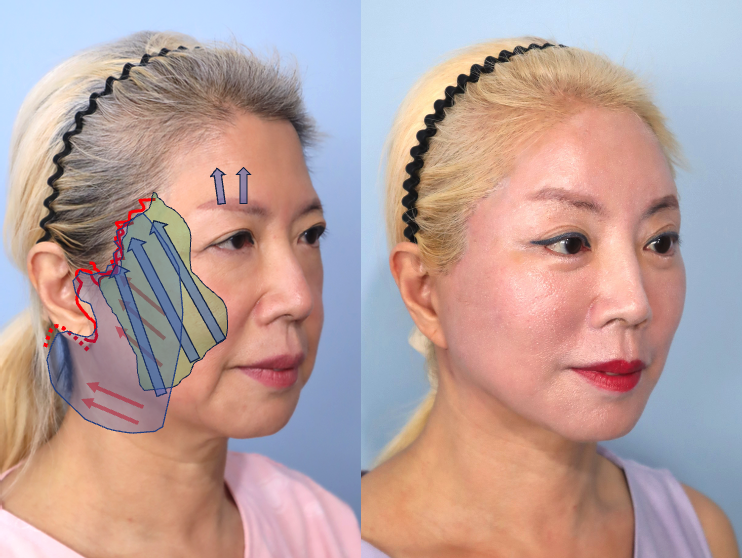
When the dissection is performed only through a temporal incision, the dissection range of a mini facelift becomes limited, making it difficult to tighten the SMAS deeply and also restricting the area that can be lifted.
In contrast, when the incision is extended and the dissection is carried forward to the area in front of the ear, deeper dissection can be performed all the way to the nasolabial fold area, and
This allows the SMAS to be lifted more comprehensively, distributing tension evenly and creating a natural and smooth lifting effect.
In other words, because the dissection range in a mini facelift is narrow, the duration of its results may be shorter, and
Conversely, a full facelift has a wider dissection range, which structurally allows for a longer-lasting result.
🌿 The advantages of a mini facelift are its quick recovery and easy, low‑burden accessibility.
A mini facelift has the advantages of a small incision range and a limited dissection area, resulting in a shorter operation time. Swelling also subsides quickly, allowing for a faster return to daily activities.
Thanks to these characteristics, it is a low‑burden lifting procedure for people with busy schedules or office workers, and is especially preferred by those who cannot afford a long recovery period.

It is also suitable for those who want a natural and subtle lifting effect at an early stage of facial sagging, and is widely chosen because it allows for a conservative approach even when only specific areas are of concern.
🎯 After the age of 40, a full facelift is often more suitable.
Director Kim Hyun‑cheol explains, “After the age of 40, overall facial sagging begins, so a minimal‑incision full facelift is often more suitable than a mini facelift.”
Your 40s are when skin elasticity begins to decline significantly. It’s not just one or two areas that start to sag — the overall facial volume descends, the midface begins to hollow, the jawline loses definition, and the neck line starts to sag, leading to multiple combined changes.
Especially after the mid‑50s, neck wrinkles and neck skin laxity often appear together, so combining a facelift with a neck lift provides more natural and harmonious results.
However, being older does not necessarily mean that a major surgery is required. If the degree of facial sagging is not severe, a mini facelift can still be an appropriate option.
Ultimately, what matters most is not age, but the degree of facial sagging and each individual’s facial structure.
⚠️ A realistic explanation of the potential complications of facelift surgery and how to prevent them
The most concerning complication in facelift surgery is facial nerve injury.
Many people worry that facial nerve damage may cause symptoms such as inability to move the eyebrow or asymmetry of the mouth. However, in most facelift surgeries, SMAS fixation is performed using dissolvable sutures, so even if temporary paralysis occurs, it typically recovers within two weeks, and permanent nerve damage is extremely rare.
Smokers have poor skin blood circulation, which increases the risk of skin necrosis. Because smoking constricts blood vessels and reduces skin blood flow, postoperative recovery is slower, and scars may become more noticeable.
In some cases, postoperative swelling may persist for a long time. Individuals who have previously undergone jaw surgery or major bone surgery often have reduced blood circulation, which can prolong swelling, and in severe cases, may even lead to recurrent sagging.
Such situations can occur in both mini facelift procedures and full facelift surgeries.
Ultimately, the key to minimizing complications lies in the delicate dissection and natural tension applied by an experienced specialist.
Kidari Plastic Surgery Clinic website beanpoleps.com/inc/index.php
❓ FAQ
1. Is the duration of a mini facelift result short?
Because the dissection range is smaller, the duration of results may be shorter than that of a full facelift.
2. Are full facelifts more suitable than mini facelifts for people in their 40s?
After the age of 40, overall facial sagging begins, so a minimal‑incision facelift is often more suitable.
3. Is nerve damage from facelift surgery permanent?
Most cases are temporary and recover within two weeks.
4. Do smokers have a higher risk during facelift surgery?
Smokers have poor skin blood circulation, which increases the risk of skin necrosis.
5. Who is a suitable candidate for a mini facelift?
It is suitable for individuals who have sagging limited to specific areas, such as the nasolabial folds, outer corners of the eyes, or jowl area.
Discover more from Korea Doctor Interview
Subscribe to get the latest posts sent to your email.


Leave a Reply
You must be logged in to post a comment.
[…] 강남역에 위치한 키다리성형외과는 32년 경력의 성형외과 전문의가 상담부터 수술까지 1:1 전담 시스템을 […]