


There are not many dental clinics that clearly explain how to care for implants after the procedure.
Most clinics focus on placing the implant well, but only give very brief instructions about aftercare.
Dental implants are structurally different from natural teeth. In an interview, Dr. Lee Sang-chil of Guro U.D. Dental Clinic explained that unlike natural teeth, implants have a small gap between the surface and the gums, and food trapped in this gap can cause inflammation. He pointed out that many patients only brush the smooth surfaces of their teeth. He emphasized the importance of applying the concept of scaling to daily oral care.

(Dr. Lee Sang-chil, Guro U.D. Dental Clinic)
Post‑implant care is extremely important—truly essential. When you get an implant, a gap forms between the implant surface and the gums, a gap that natural teeth don’t have. Because of this structural space, food debris easily gets trapped and becomes a source of inflammation. However, most patients, out of long‑held brushing habits, only clean the smooth surfaces of their teeth and stop there.
The important thing is that food often gets packed deep between the teeth. When treating patients with implant inflammation, I often find that they never clean the inside of these interdental spaces. It’s because it feels uncomfortable, scary, and difficult to put something like a toothbrush or floss between the teeth. It can even hurt.
That’s why, even if it feels uncomfortable, the bristles must go into the space between the teeth. If you move the toothbrush too much while inserting it, it will never enter the gap. You need to apply slight pressure and push the bristles into the space, almost like inserting them gently. Once inside, you should feel the bristles moving—either from the gums or even from the tongue on the opposite side if the gap is large.
So you need to brush gently, as if massaging, to properly clean the inside of the interdental space.
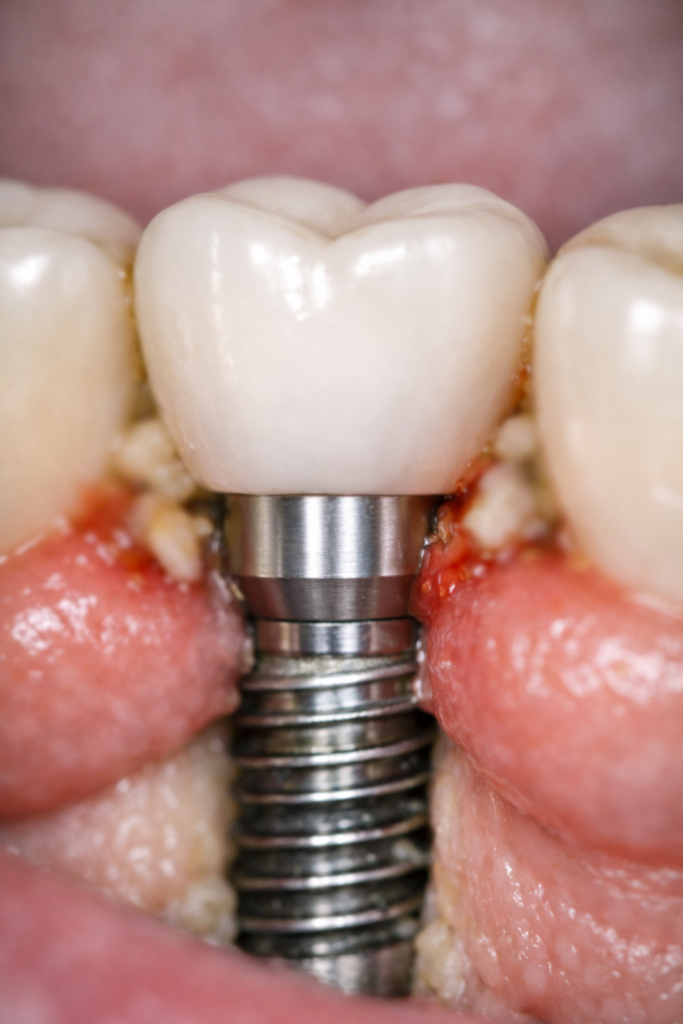
You must clean between your teeth. Brushing only the outer surfaces is never enough. The same goes for the inside surfaces—there are gaps there too, and the bristles need to go in. Every tooth has spaces. It’s okay to push the bristles into those gaps.
If you’re not used to doing this, your gums may bleed at first. That’s okay. With consistent cleaning, your gums become stronger, the bleeding decreases, and it even provides a gum‑massage effect.
It’s like cleaning a window—if you only wipe the large glass surface but don’t clean the window frame, dust will build up there.
It’s just like when the dentist cleans everything, but the window frame is left dirty—food debris will still be stuck there. That’s why you must pay attention to cleaning that “frame.” If you clean the gum gaps well, the smooth tooth surfaces naturally get cleaned too. If you feel it’s still not enough, you can brush horizontally once more. But the most important thing is thoroughly cleaning those gaps.
The smooth surface of teeth is glass‑like, so implants don’t easily develop cavities even if some food sticks to them. What really matters is the gap inside the gums.
Another point is that a regular toothbrush has length limitations—it can’t always reach deep into the spaces between teeth. Since the bristles must reach deep into those gaps, using an interdental brush is much more effective.

Interdental brushes are small and long, so they fit well into the gaps. Push them in as far as they will go and clean slowly and thoroughly, making sure not to miss any spot.
This method is good not only for implant patients but also for those with periodontal disease who have larger gaps between their teeth.
Using interdental brushes, dental floss, and a water flosser is very effective.
Most people visit the dentist to get scaling done. If you pay attention to what the dentist actually cleans, you’ll understand the key point.
During scaling, they don’t focus on the wide, smooth surfaces of the teeth. What they clean is the gap between the teeth and the gums.
So if you clean that same area at home every day, just like the dentist does during scaling, you won’t develop tartar.
In my case, I haven’t had scaling done in over 10 years—because proper brushing takes care of everything.
Where does the dentist clean during scaling? That exact area.
If you focus your brushing on that spot, whether you have natural teeth or implants, you won’t get tartar and your mouth will stay very clean.
Proper placement of an implant is important, but its lifespan is determined by how well you care for it. Thank you.
Discover more from Korea Doctor Interview
Subscribe to get the latest posts sent to your email.


