

No‑Prep Laminates – A Modern Treatment Guide for Preserving Teeth and Achieving Natural Aesthetics

Advantages, Precautions, and Suitable Cases of No‑Prep Laminates as Explained by Dr. Jung Eun‑young of Tiffany Dental Clinic at Sangdong Station in Bucheon
🟩 Why No‑Prep Laminates Are Gaining Attention
No‑prep laminates have recently been receiving significant attention in the field of aesthetic dentistry.
Because it allows aesthetic improvement while minimizing tooth reduction.
Because traditional laminates required extensive reduction of the tooth surface
⚠️ There were many cases where various side effects such as sensitivity, debonding, and fractures occurred.
To reduce these burdens, a method that minimizes tooth reduction was introduced,
🌿 It is receiving great attention from patients who value the preservation of their natural teeth.

(Director Jung Eun‑young, Tiffany Dental Clinic)
This article is based on an interview with Dr. Jung Eun‑young of Tiffany Dental Clinic, drawing from her real clinical experience and treatment philosophy regarding no‑prep laminates.
Dr. Jung emphasized that “teeth should not simply be made whiter, but should be treated with consideration for the harmony of the entire face,” and
She explained how to achieve natural results while minimizing tooth reduction.
🟩 The Difference Between Traditional Laminates and No‑Prep Laminates
Traditional laminates required extensive tooth reduction to make space for the thicker prosthetic material.
In contrast, no‑prep laminates use ultra‑thin prosthetics of about 0.2–0.3 mm, minimizing the amount of tooth reduction.
The advantages of no‑prep laminates are,
- There is minimal damage to the teeth.
- Sensitivity and pain are reduced.
- The preservation rate of natural teeth is high.
- The risk of debonding is low.
- The psychological burden is reduced.
The goal of tooth shade improvement is not simply to make the teeth brighter.
It is important to find a natural shade that harmonizes with the entire face.
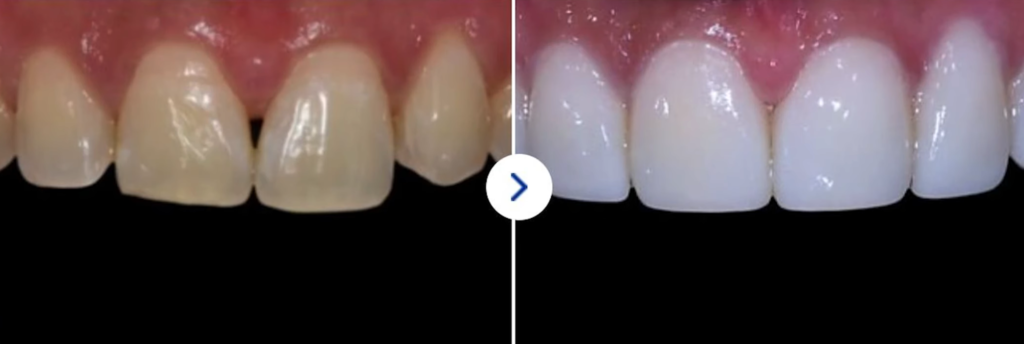
(Before and After No‑Prep Laminate Treatment)
The following factors are considered when selecting the tooth shade.
No‑prep laminates are not simply about attaching thin prosthetics; they involve a precise design process that considers the harmony of the entire face.
The factors considered during the design process are
- Facial shape and lip line
- Amount of tooth exposure when smiling
- Tooth angle and length
- Tooth width‑to‑length ratio
- Gum line and smile line
- Tooth translucency and surface texture
When these factors are precisely reflected, a natural and harmonious result is achieved.
🟩 Criteria for Selecting the Shade of No‑Prep Laminates
The goal of tooth shade improvement is not simply to make the teeth brighter.
It is important to find a natural shade that harmonizes with the entire face.
The factors considered when selecting the shade are
- Skin tone
- Lip and gum color
- Natural tooth translucency
- Professional characteristics
- The amount of tooth display when smiling
No‑prep laminates offer a wide range of shade options, allowing choices from natural tones to bright and vivid ones.

🟩 The Importance of the Bonding Process
The precision of the bonding process determines the outcome of no‑prep laminates.
Although this process is not visible to the patient, it is a key step that determines the stability and durability of the treatment.
The key factors in the bonding process are❗
- Tooth surface pretreatment
- Internal surface treatment of the prosthesis
- Selection of the bonding agent
- Light‑curing intensity and time
- Fine adjustment of the prosthesis position
- Removal of adhesive residue
- Smooth transition of the interface
This process must be precise to prevent issues such as debonding, discoloration, and gum inflammation.
🟩 Durability: Why it is thin yet strong
No‑prep laminates are often misunderstood as being weak because they are thin, but…
In reality, the thin structure integrates naturally with the tooth, helping enhance overall strength.
The reasons for its strength are as follows.
- Minimal tooth reduction allows the natural structure to be preserved.
- Through bonding technology, the tooth and the prosthesis unite as a single structural unit.
- Thin prostheses naturally disperse external forces.
- It has a lower risk of debonding compared to thicker prostheses.
In other words, it is not weak because it is thin — its thinness actually allows for more stable results.
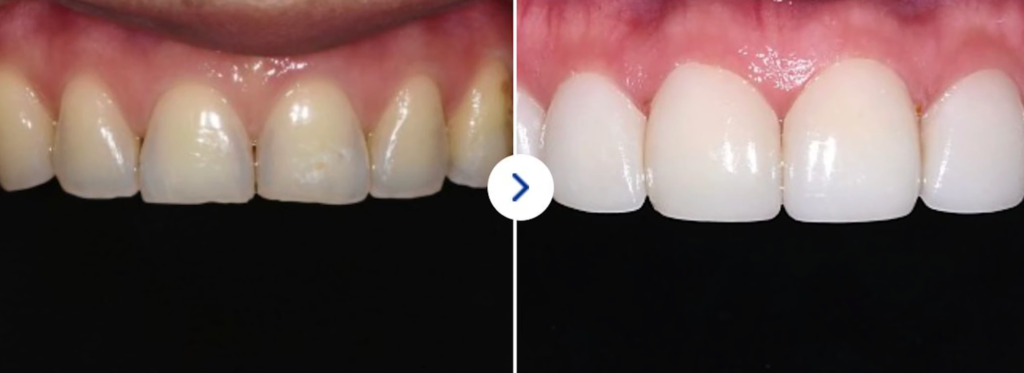
(Before and After No‑Prep Laminate Treatment)
🟩 Suitable cases and unsuitable cases
The cases in which no‑prep laminates are particularly suitable are as follows.
- Microdontia (small teeth)
- Barrel‑shaped teeth
- When there is a wide space between the teeth
- Black triangle after orthodontic treatment
- When permanent tooth whitening is desired
❗Conversely, it may not be suitable in the following cases.
- When there is deep dental decay or existing restorations
- When the teeth are severely protruded
- When there is severe tooth misalignment
- When there is severe tooth wear
No‑prep laminates provide not only aesthetic improvement but also positive psychological changes.
The changes patients experience after treatment are
- You’ll no longer feel the need to cover your smile.
- Taking photos becomes enjoyable.
- Meeting people becomes more comfortable.
- You gain confidence during presentations and conversations.
🟩 Relationship with orthodontic treatment
No‑prep laminates are not a substitute for orthodontic treatment.
Mild alignment issues can be corrected with laminates, but moderate to severe cases require orthodontic treatment first.
Conversely, black triangles or color dissatisfaction that occur after orthodontic treatment can be naturally improved with laminates.

✨Tiffany Dental Clinic Website https://www.tifdc.com/index.php✨
🟩 Care Methods and Maintenance Tips
Proper care is essential to extend the lifespan of no‑prep laminates.
- Use dental floss consistently.
- Avoid biting hard foods with your front teeth.
- Have regular check‑ups every 6 to 12 months.
- Wear a night guard if you grind your teeth.
💬 Even with just these care habits, you can significantly extend the lifespan of your restorations.
💎 FAQ (FnA)
1. Do no‑prep laminates really require no tooth reduction at all?
Complete no‑prep laminates are possible in some cases, but minimal reduction may be needed when there is protrusion or alignment issues.
2. How long can no‑prep laminates last?
As long as the restoration does not fracture or detach, it can be used long‑term, and proper care can significantly extend its lifespan.
3. Is there any sensitivity or pain?
Because the amount of tooth reduction is minimal, sensitivity or pain is usually less than with traditional laminates.
4. Does it look natural?
Because the design considers your facial shape, tooth form, and shade, you can expect a very natural result.
5. How long does the treatment take?
It is usually completed in 2–3 visits and tends to proceed faster than traditional prosthetic treatment.
Discover more from Korea Doctor Interview
Subscribe to get the latest posts sent to your email.



Leave a Reply
You must be logged in to post a comment.
[…] […]