After Plastic Surgery in Korea: Get Your Medical Records Before Flying Home for Follow-Up Care Back Home

After surgery in Korea and the flight home, there may come a time when the swelling lasts longer than you expected or the scar area bothers you, and you'd like to see a doctor near home. But that doctor will want to know what surgery you had and how it was done — and the clinic that operated on you is across the sea in Korea. That's when a copy of your Korean medical records is the most reassuring thing to have in hand.
I wondered what I'd need if I ended up seeing a doctor back home, so I looked into how to get copies of medical records in Korea and which documents are worth having. You can sort all of this out with just one day set aside before you fly home.
You can request copies of your own medical records
Article 21 of Korea's Medical Service Act says patients may view their own medical records or request copies, and medical institutions may not refuse without a legitimate reason. Being a foreign patient doesn't change that. Just tell the front desk or the consultation office at your clinic that you'd like copies of your medical records; they'll usually check an ID such as your passport.
The fees aren't a burden either, because Korea's Ministry of Health and Welfare sets upper limits. When I checked one Korean university hospital's notice in November 2026, records cost about $0.70 (₩1,000) per page for pages 1–5, about $0.07 (₩100) per page from page 6, and about $7 (₩10,000) per imaging CD. Amounts may differ slightly by clinic, so ask when you apply. (USD figures are approximate and depend on the exchange rate.)
Documents worth getting before you fly home
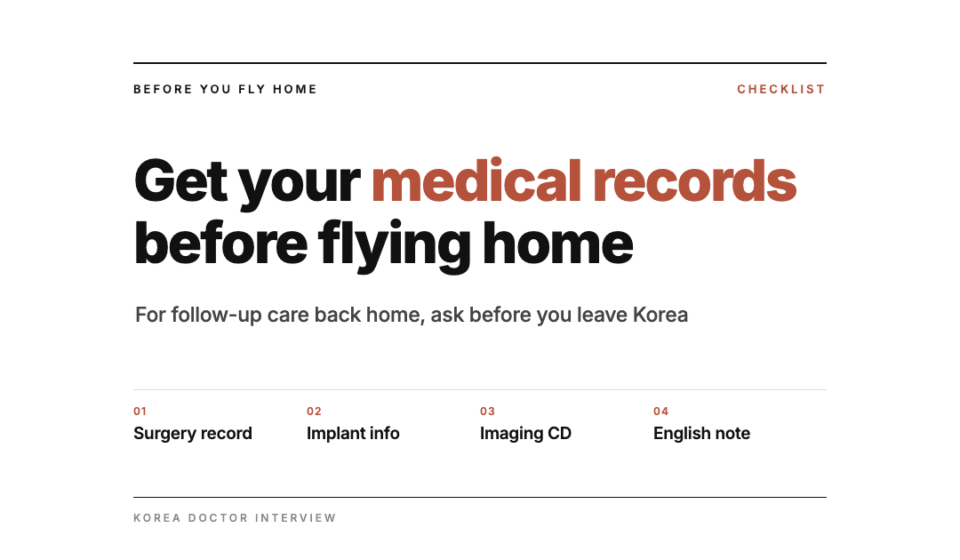
Surgery record: the first document to ask for. It shows which method was used on which area, so a doctor back home has a baseline for judging your condition.
Anesthesia record and prescriptions: get these too. Knowing what anesthesia you had and which medicines were prescribed makes it easier to explain things when you're prescribed something new back home. I've covered the rules for bringing Korean prescriptions into Japan separately in Can You Bring Post-Surgery Medication from Korea into Japan? The 1-Month Rule and Sleeping Pill Warnings.
Implant details, if you had one: be sure to check these. If an implant was used in nose or breast surgery, details such as the product name and size may be needed later for follow-ups or if you ever consult about revision. Some clinics hand out a separate product card or sticker, so ask about it during your pre-surgery consultation.
Test results and imaging: nice to have as well. Blood test results from before surgery and images such as CT scans or X-rays can be issued on CD. Some hospitals issue imaging CDs only in person, so it's easiest to apply on the day of your last follow-up visit before you leave.
Before-and-after photos: it's also worth asking whether you can get these. Having photos from right after surgery helps when comparing how the swelling goes down. Whether photos are provided differs by clinic.
Can a doctor back home read Korean records?
Medical records are written in Korean, sometimes with medical terms in English mixed in. Since they can be hard to read as they are, ask whether you can also get a doctor's note in English covering at least the procedure name, the surgery date and any implant used. A doctor's note or medical certificate is a new document the doctor writes, so it's charged separately from record copies. I covered the surgery certificate you may need when leaving Korea in Leaving Korea After Plastic Surgery: What If Your Face No Longer Matches Your Passport?— if you ask for everything at the same time, you won't have to go back to the clinic twice.
Before you go to a hospital back home
In Japan, cosmetic surgery is also outside public health insurance and treated as private (self-pay) care. Whether a hospital will follow up on surgery done elsewhere, and whether insurance can be used, depends on your symptoms and the hospital's policy, so you can't know in advance. That's why it's best to call first and say you'd like a follow-up check on surgery you had in Korea, and then bring your record copies once they confirm they can see you.
On the other hand, if you have urgent symptoms such as a fever or sudden swelling and pain at the surgical site, getting to a nearby hospital right away comes before gathering documents. Having photos of your surgery record saved on your phone makes them easy to show in that situation.
Frequently Asked Questions
Q. Can I request copies after I've gone home?
Records are kept by the hospital for a period set by law, so you can still request them later. But if you can't go in person, a family member or representative has to bring the consent and power-of-attorney forms specified by law, a copy of your ID and so on, which makes it a hassle. Whether a clinic will send copies abroad by mail or email also varies, so it's much easier to get them while you're still in Korea.
Q. Will the clinic be offended if I ask for copies?
Record copies are something patients are entitled to request, so there's no need to feel awkward. Explaining that you plan to have follow-ups back home also makes it easier to talk about which documents you need.
Q. How long does it take to get them?
Some documents are issued on the spot, but a doctor's note or English documents the doctor has to write from scratch can take time. Apply a few days ahead rather than on the day you leave.
Wrapping up
Ideally you'll never need to see a doctor back home, but just in case, getting your surgery record, anesthesia and prescription records, implant details, imaging and an English doctor's note while you're still in Korea will give you real peace of mind. I recommend asking for all of it at once on your last follow-up visit before you leave.
※ This article is general information compiled as of November 2026 with reference to Korea's Medical Service Act and publicly posted hospital fee notices. Document types, issuing procedures and fees may differ by clinic, so check directly with the clinic where you have surgery. For whether you can be seen back home and whether insurance applies, ask the hospital you plan to visit.
Medical Information Notice
This article provides general information based on interviews with medical professionals and publicly available sources, and it does not replace personal diagnosis or treatment. Symptoms and treatment results vary from person to person, so always consult a specialist in person before deciding on any procedure or treatment.
Discover more from Korea Doctor Interview
Subscribe to get the latest posts sent to your email.