Plastic Surgery Consent Forms in Korea: What to Check Before Signing If You Can't Read Korean

As your surgery date in Korea gets close, there's one last document you'll be handed in the consultation room: the surgery consent form. If you've come from abroad, sitting in front of several pages of Korean while someone says "Please sign here" can feel overwhelming. Picking up the pen without being able to read what you're agreeing to is more unsettling than you'd think.
I wondered about this too, so I looked into what consent forms usually contain and what's worth checking when you can't read Korean. Every clinic uses its own form, so I've focused on points you can check at any clinic.
What does a consent form usually include?
Korea's Medical Service Act has a provision (Article 24-2) requiring doctors to explain and obtain written consent before procedures that can seriously affect the body, such as surgery or general anesthesia. That's why signing a consent form before plastic surgery is standard.
To get a feel for what's included, I found a bilingual Korean–Japanese consent form template (March 2018 edition) that Japan's Ministry of Health, Labour and Welfare publishes for treating foreign patients helpful. It's meant for Japanese hospitals, but it lists items such as the purpose and details of the treatment, the risks and how often they occur, what happens if a complication arises, alternative treatments, the name of the doctor who explained it, and the fact that you can withdraw your consent.
What to check before you sign
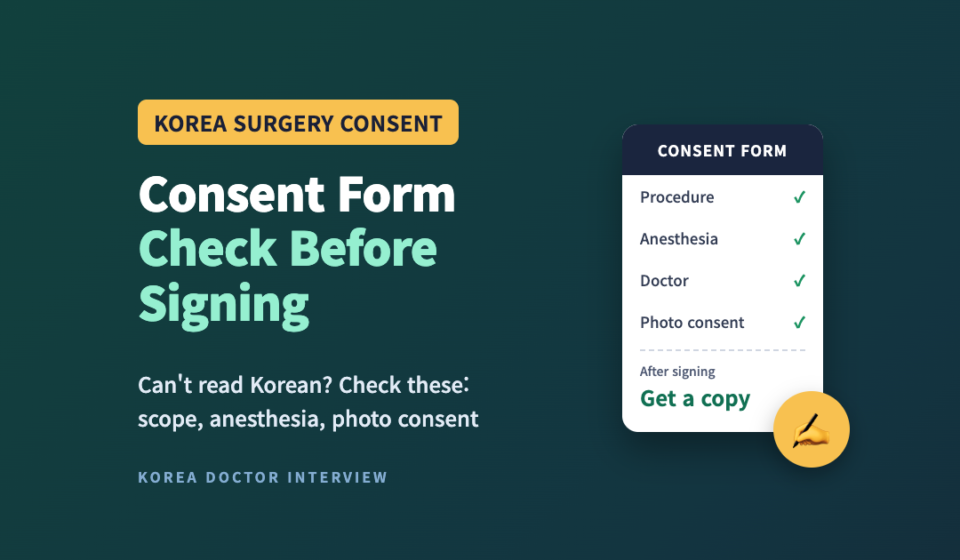
Procedure name and scope: start by checking they match what you discussed. For a nose job, for example, see whether the implant or cartilage and any extra areas you agreed on are written as discussed. Laying it next to your quote makes it easier not to miss anything.
Anesthesia method: this matters too. Fasting before surgery and recovery time differ depending on whether it's sedation, general anesthesia or local anesthesia, so check that the method on the form matches what you were told.
The name of the doctor who explained it: it's worth checking it's written down. If questions come up on surgery day or you want to ask about your recovery after going home, knowing who explained things to you makes everything much quicker.
The section on side effects and risks: keep asking until it makes sense. At the very least, have someone explain in your language how long swelling and bruising last and which symptoms mean you should contact the clinic right away.
Your follow-up appointment schedule: check again that it fits your departure date. If the day stitches come out or your last check-up falls after your flight home, you'll need to adjust the schedule in advance.
Consent for taking and using photos: see whether there's a separate item for it. Some clinics ask for separate consent for photos used in your medical records and before-and-after photos used for promotion. So that you can decide for yourself how far you agree, listen carefully to what this item covers before ticking it.
Finally, once you've signed the consent form, ask for a copy. The MHLW form also states that a copy is given to the patient after signing. At a Korean clinic, too, ask whether you can get a copy when you sign.
If you can't read Korean
If an interpreter or international coordinator is with you, ask them to go through the items above one by one rather than just telling you "it's all fine overall." Jotting down your questions beforehand helps you not miss anything even when you're nervous.
If possible, ask whether you can see the consent form a few days before surgery day. That way you can read it slowly with a translation app's photo feature. App translations can render medical terms awkwardly, though, so it works best for marking the parts you don't understand and asking about them in person on the day.
If you change your mind after signing
The MHLW form includes a line saying you can withdraw your consent at any time, even after agreeing. If you change your mind before surgery, don't agonize over it alone — tell the clinic right away. Whether you can get your deposit back, however, depends on each clinic's policy, so it's best to check the conditions before you pay. I've covered deposits and payment methods separately in Paying for Plastic Surgery in Korea: Card, Cash or Yen? Japanese Card Fees and Why to Pay in Won.
Frequently Asked Questions
Q. Can I get a consent form in English or Japanese?
It depends on the clinic. Some have consent forms prepared in other languages, while others go through the Korean document with an interpreter. Asking at the consultation stage saves you from surprises on the day.
Q. Can I take a photo of the consent form with my phone?
It's best to first ask whether you can get a copy. If you'd like to take a photo, ask the clinic for permission first.
Q. What if I still don't understand after the explanation?
It's fine to ask again until you understand. A consent form is a document you sign knowing what you're agreeing to, so if questions remain, hold off on signing for a moment and ask for more explanation.
Wrapping up
Even if you can't read every word of a Korean consent form, checking a handful of points — the procedure and its scope, anesthesia, the doctor who explained it, side effects, the follow-up schedule and photo consent — makes it much clearer what you're signing. And once you've signed, be sure to keep a copy; it helps if you see another doctor after you go home.
※ This article is general information compiled as of November 2026 with reference to Korea's Medical Service Act and the bilingual consent form template (March 2018 edition) from Japan's Ministry of Health, Labour and Welfare. The exact content and process of consent forms may differ by clinic, so please check directly with the clinic where you're having surgery.
Medical Information Notice
This article provides general information based on interviews with medical professionals and publicly available sources, and it does not replace personal diagnosis or treatment. Symptoms and treatment results vary from person to person, so always consult a specialist in person before deciding on any procedure or treatment.
Discover more from Korea Doctor Interview
Subscribe to get the latest posts sent to your email.