


One of the most frequently asked questions from people who come for a hump‑nose surgery consultation is
It is the part where people ask, “Do you really need to shave the bone even if the hump on the nose is only slight?”
Many people think that hump‑nose surgery always involves shaving the nasal bone, but in reality, that’s not always the case, and
the point that letting go of the fixed idea that hump‑nose surgery must involve bone shaving is actually a much safer and more reasonable approach,
I conducted an interview with Director Hwang Kyuseok of Homme & Femme Plastic Surgery.

Hump noses are generally classified into two types: true humps and pseudo humps, and
Although these two types may look similar on the surface, the correction methods are completely different, and the key point is that pseudo humps can often be resolved fully without shaving the bone.
• True Hump (True Hump) — when the nasal bone itself is prominently elevated
A true hump refers to a case where the nasal bone itself is prominently elevated, giving the appearance of a hump similar to that often seen in Western noses.
In this case, because the nasal bone is actually protruding, some degree of bone reduction may be required during surgery.
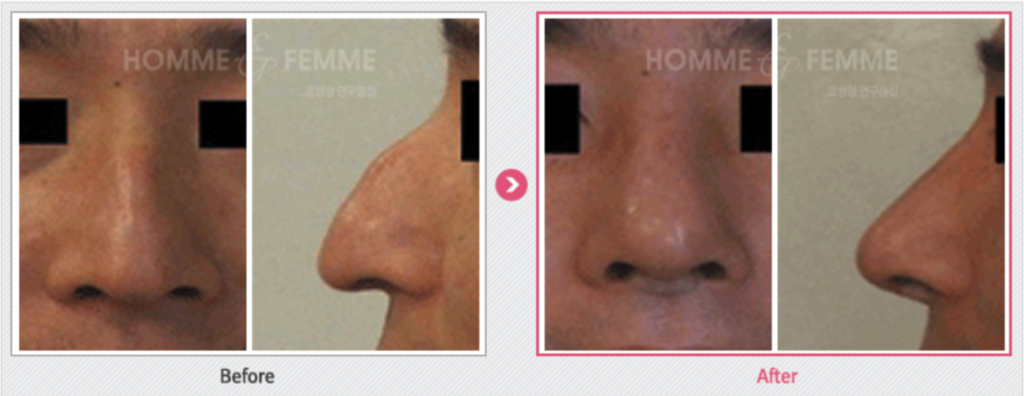
After the surgery,
- lowering the protruding bone
- lifting the drooping nasal tip
- the overall nasal line is refined to connect smoothly and naturally.
In other words, a true hump may require bone reduction, but
it is important to avoid excessive reduction and adjust only the minimum amount necessary.
• Pseudo Hump (Pseudo Hump) — a ‘false hump’ created by a low nasal bridge and a drooping tip
A pseudo hump may look like a real hump on the surface, but in reality
- the nasal bridge is low and
- the nasal tip is drooping, so
it is an optical illusion that occurs.

In this case, the hump-like appearance is not caused by a raised bone, but by the combination of a low nasal bridge and a drooping tip. Therefore, shaving the bone is unnecessary and may even be risky.
Pseudo‑prostitution is resolved in the following way.
- It naturally raises a low nasal bridge.
- Lifting the drooping nasal tip
The part that looked like a hump disappears naturally.
Director Hwang Gyuseok emphasizes that fake humps should never be corrected by shaving the bone.
Shaving the bone weakens the structure and can affect the long‑term stability of the nose.
• Hump nose self‑diagnosis checklist — Am I genuine or pseudo?
If three or more of the items below apply to you, it is highly likely to be a pseudo hump.
- The nasal bridge is low but only the middle part looks protruded.
- The tip of the nose is drooping downward.
- The tip of the nose drops even more when smiling.
- From the side view, the nasal bridge looks lower than the tip of the nose.
- It looks fine from the front, but only the side view bothers me.
- After the filler, the hump looked even more pronounced.
Conversely, if the items below apply to you, it is highly likely to be a true hump.
- The entire nasal bridge feels high and firm to the touch.
- There is a feeling that the nasal bone itself is actually protruding.
- The tip of the nose is normal, but the middle of the nasal bridge is unusually high.
- There are many people with a hump nose in my family.
• Various ways to correct a hump nose without shaving the bone
- Naturally raises the low nasal bridge using an implant or autologous tissue.
- Strengthens the support of the nasal tip to correct drooping.
- Lifts the nasal tip to smoothly connect the overall line.
- The protruding area is naturally covered by adjusting the thickness of the implant.
- If needed, the nasal tip structure is stabilized using septal cartilage.
This method…
- Recovery is quick and…
- Swelling and bruising are minimal, and…
- It is stable in the long term, and…
- It is easy to create a natural line.

• Precautions before and after hump‑nose surgery
Before the surgery
- If you have nose fillers, it is recommended to dissolve them 2–4 weeks before the surgery.
- Check for a deviated septum or rhinitis.
- Analyzing skin thickness, cartilage structure, and nasal tip support is essential.
- Accurately inform your doctor about any previous surgeries.
After the surgery
- Avoid wearing glasses for 1–2 weeks.
- Avoid rubbing or touching your nose forcefully.
- Avoid sleeping on your stomach.
- Intense exercise can be resumed after 2 weeks.
- Saunas and steam rooms should be avoided for 3–4 weeks.
- Swelling management should follow the order of cold compress → warm compress.
• Comparison of long‑term durability of hump‑nose surgery
Bone‑shaving method
- Possibility of absorption or irregularities in the resected area
- Weak against external impact
- Possibility of internal structural instability
- Increased difficulty for revision surgery
A method that does not involve shaving the bone
- High stability due to structural preservation
- Excellent long‑term durability when nasal tip support is reinforced
- Maintaining a natural line
- Low likelihood of requiring revision surgery
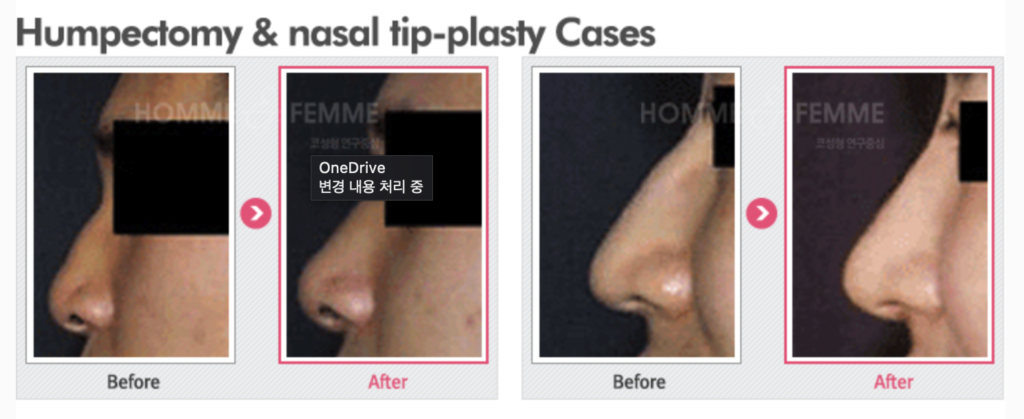
Hump‑nose surgery is not simply about shaving the bone just because a hump is visible.
The most important thing is to accurately distinguish whether it is a true hump or a pseudo‑hump. In the case of a pseudo‑hump, you can create a sufficiently beautiful line without shaving the bone.
In fact, the method that does not involve shaving the bone
- Safer
- More natural
- More stable in the long term
- The likelihood of needing revision surgery is also low.
Therefore, if you are considering hump‑nose surgery, it is best to thoroughly consult a specialist to see whether it can be done without shaving the bone.
Homme & Femme Plastic Surgery Clinic Website http://dr4nose.com
• Frequently asked questions during actual consultations (FAQ)
Q1. Do I need surgery even if the hump on my nose is only slight?
A. No. If it is a pseudo‑hump, it can be corrected without shaving the bone.
Q2. Can a hump nose be corrected with fillers?
A. It is possible temporarily, but it cannot provide a structural correction.
Q3. Why does the hump on my nose look more pronounced only when I smile?
A. It is due to the muscle that pulls the nasal tip downward and a lack of structural support.
Q4. Will the hump disappear if I only raise the nasal bridge?
A. It is possible if it is a pseudo‑hump, but a true hump requires separate correction.
Q5. Can the hump come back after surgery?
A. If the structural support is reinforced properly, the chance of recurrence is very low.
Q6. Does lifting the nasal tip too much make the overall impression look stronger or harsher?
A. If the nasal tip is raised at a natural angle, it actually creates a softer impression.
Q7. Do men also get hump‑nose surgery often?
A. The proportion of male patients has been steadily increasing.
Q8. How long does the swelling last after hump‑nose surgery?
A. Most of the swelling subsides by 12 weeks, and it looks natural around 13 months.
Q9. Is it possible to do it without an implant?
A. Depending on the case, it can be done using only autologous tissue.
Q10. Is it dangerous to shave the nasal bone?
A. It is safe when necessary, but unnecessary removal should be avoided.
Q11. Is revision surgery also possible?
A. Yes, it is possible. It is often performed especially when the bone becomes uneven after reduction.
Q12. Is a natural-looking result possible?
A. When approached with a structure‑preserving method, the results are very natural.
Homme & Femme Plastic Surgery follows a surgical philosophy that preserves structure without excessive resection,
And we focus on achieving long‑term stability through an approach that strengthens tip support.
Discover more from Korea Doctor Interview
Subscribe to get the latest posts sent to your email.


