Gangnam Rhinoplasty: What Is Jaryeohan Rhinoplasty? Bridge & Nose Tip Design and Recovery Time | Marble Plastic Surgery, Dr. Seo Il-beom


Anyone researching a nose job in Seoul eventually faces the same dilemma: “I don’t want a nose that screams surgery, but wouldn’t it be a waste if no one could tell I had it done?” That very question is what gave rise to Jaryeohan rhinoplasty, a term that combines the Korean words for “natural” and “glamorous,” and one of the most common keywords in Korean rhinoplasty consultations today.
Yet a natural-yet-glamorous nose cannot be copied from a single photo. The same bridge height can look natural on one person and excessive on another, depending on face length, the height of the forehead and glabella, and skin thickness. In this guide, drawing on the clinical materials of Dr. Seo Il-beom, Chief Director of Marble Plastic Surgery near Gangnam Station and Sinnonhyeon Station, we walk step by step through what a Jaryeohan nose really means, its design criteria, surgical methods and recovery.
📌 What this article covers
1. What Jaryeohan rhinoplasty means – how it differs from a natural nose and a glamorous nose
2. 3 design points that define a natural-yet-glamorous nose
3. Rhinoplasty methods by nose type: bulbous nose, hump nose and more
4. 3D-CT analysis, custom nose implants and nose tip surgery
5. Rhinoplasty recovery time and surgery information
6. How to choose a rhinoplasty clinic in Gangnam
7. Marble Plastic Surgery: medical team, location and hours
8. FAQ: rhinoplasty side effects, revision rhinoplasty and more
What does Jaryeohan rhinoplasty mean, in one line?
Jaryeohan rhinoplasty is a Korean rhinoplasty design that keeps the bridge natural for your face while giving the nose tip a crisp, refined accent. It is not a formal medical term, but it is widely used to describe the overall “mood” of a surgical result.
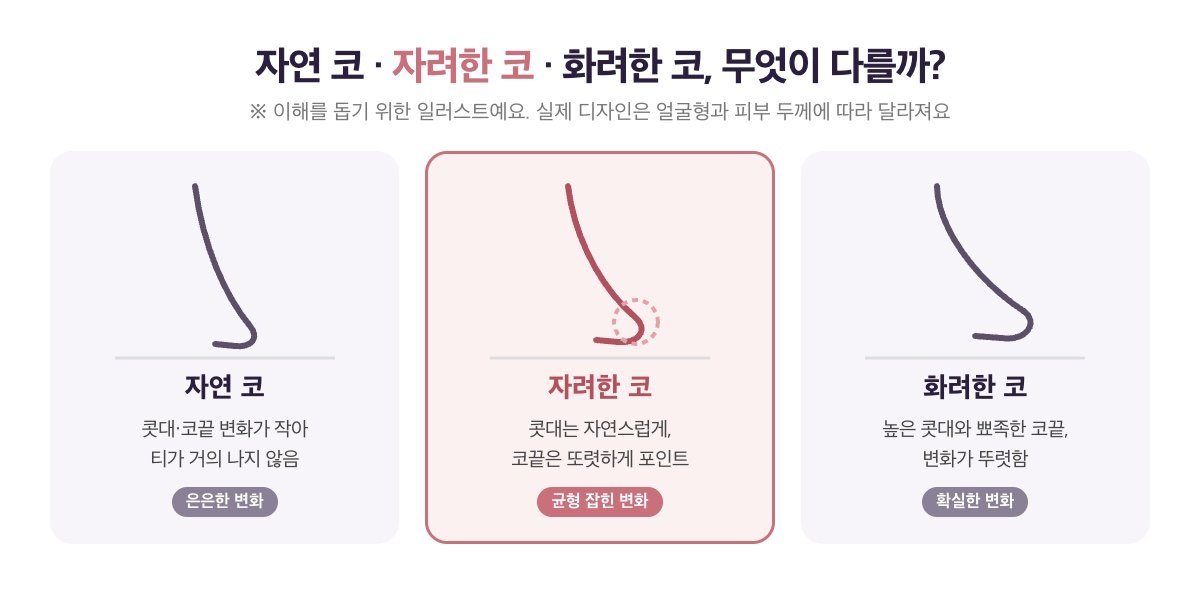
| Category | Natural nose | Jaryeohan nose | Glamorous nose |
|---|---|---|---|
| Bridge | Slight enhancement of the original height | Height that flows naturally from the forehead and glabella | High, straight line |
| Tip | Little change in shape | Neatly defined with a subtle accent | High and sharply emphasized |
| First impression | Almost no sign of surgery | A refined change – “something looks different” | Clearly noticeable change |
| Best suited for | For those concerned about how coworkers and others will react | For those who want a natural result without any regrets | For those with large, prominent facial features |
The important point is that none of the three is “good” or “bad.” Even for the same Jaryeohan nose, the bridge height and tip shape must differ for a long face versus a short one, or thick skin versus thin skin. That is why natural-yet-glamorous rhinoplasty begins by looking at your own facial proportions before the photo you want, not the other way around.
3 design points that define a natural-yet-glamorous nose
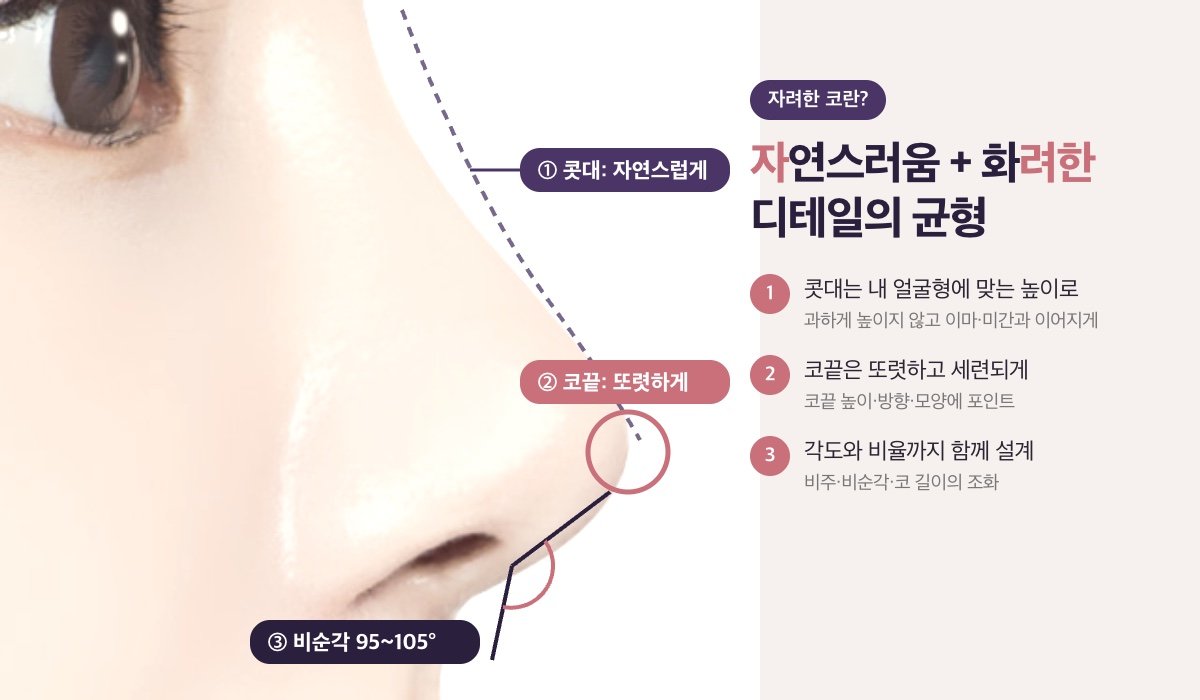
① Bridge – the starting point matters more than the height
Raising the bridge as high as possible may look glamorous, but if it shoots up abruptly from between the brows, the impression becomes harsh and the surgery shows. A Jaryeohan nose starts by deciding the height and position of the nasion (the nose starting point), so that the bridge flows smoothly from the forehead and glabella. For people with a very low glabella, refining the starting point can make a bigger difference than the bridge itself.
② Tip – most of the “glamorous” feel comes from here
Even with a subtle bridge, a well-defined tip makes the whole face look more refined. That is why the height, direction and width of the tip are refined together with its relationship to the alae. Korean nose tip surgery varies by case: for a bulbous nose, the spread cartilages are brought together; for a low tip, height is added with autologous cartilage.
③ Angles and proportions – the profile determines the finish
One of the key standards that shapes your side profile is the angle between the nose tip and the upper lip, known as the nasolabial angle. Generally, about 95–105 degrees for women and about 90–95 degrees for men is considered a natural range, and balance is considered good when the nose length is about 1/3 of the total face length. Marble Plastic Surgery’s materials likewise present whether the nose is shorter or longer than 1/3, and whether the angle between the tip and the lip is 110 degrees or more, as criteria for deciding who needs surgery and which method to use.
💡 Check before your consultation
Do your nostrils show a lot in a front-facing photo? Does the tip look droopy in profile? Does the tip drop further when you smile? Noting these features in advance makes your natural-yet-glamorous nose design consultation much more specific.
Bulbous nose, hump nose, drooping nose tip: rhinoplasty methods by nose type
Even if everyone asks for “a Jaryeohan nose, please,” the surgical method changes when the starting nose shape is different. Here are the typical approaches by nose type introduced by Marble Plastic Surgery.
- Low nose: Both the bridge and the tip are raised, while the starting point is kept from becoming too high.
- Short / upturned nose: This is when the nostrils show a lot from the front. The nose is lengthened and the tip lowered to correct the angle, within limits that do not overstrain the skin and soft tissue. If the nose is very short, additional cartilage is placed between cartilages to gain length.
- Long nose / drooping (arrow) nose tip: This is when the tip droops downward. The alar cartilages are lifted and fixed, and the drooping septum is reduced to restore balance. A crooked nose or hump nose often accompanies it, so comprehensive correction is needed.
- Bulbous nose: This is when the tip is round and wide. The spread cartilages are tied together to slim the tip, and alar reduction may be considered as well if needed.
- Hump nose / crooked nose: The protruding nasal bone or deviated axis must be corrected first for a clean, natural-yet-glamorous line.
Because several types often occur together, in practice a bridge implant, tip surgery and lengthening are combined according to your condition to build the surgical plan.
Where precise design begins: 3D-CT analysis

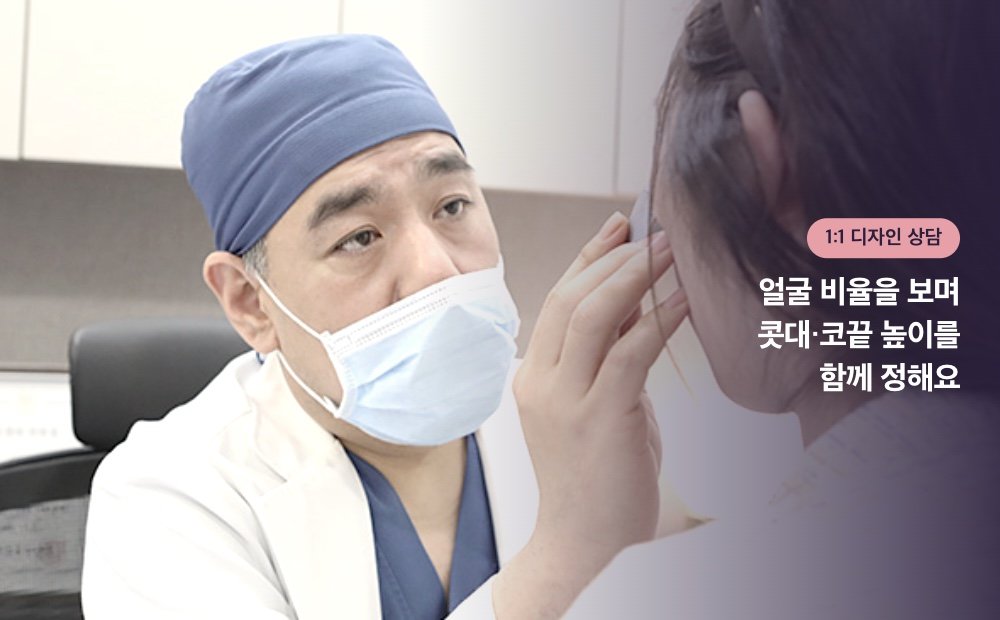
Designing from the outside alone may not achieve the desired line because of the structures inside the nose. Before surgery, Marble Plastic Surgery uses 3D-CT scanning, which checks the width of the nasal bones, the shape and size of the septal cartilage, the degree of deviation, the presence, position and type of any existing implant, and even inflammation such as sinusitis – all before a 1:1 consultation.
- If there are breathing-related problems such as a deviated septum or rhinitis, functional correction can be planned at the same time.
- For revision surgery, it helps identify the condition of the existing implant and the cause of failure, reducing the risks of a 2nd operation.
- It shows in advance whether there is enough septal cartilage for the tip, so the need for ear (conchal) cartilage or rib (costal) cartilage can be judged at the consultation stage.
A custom implant for the bridge, autologous cartilage for nose tip surgery
INOFIT custom nose implant – a bridge made to fit your nose
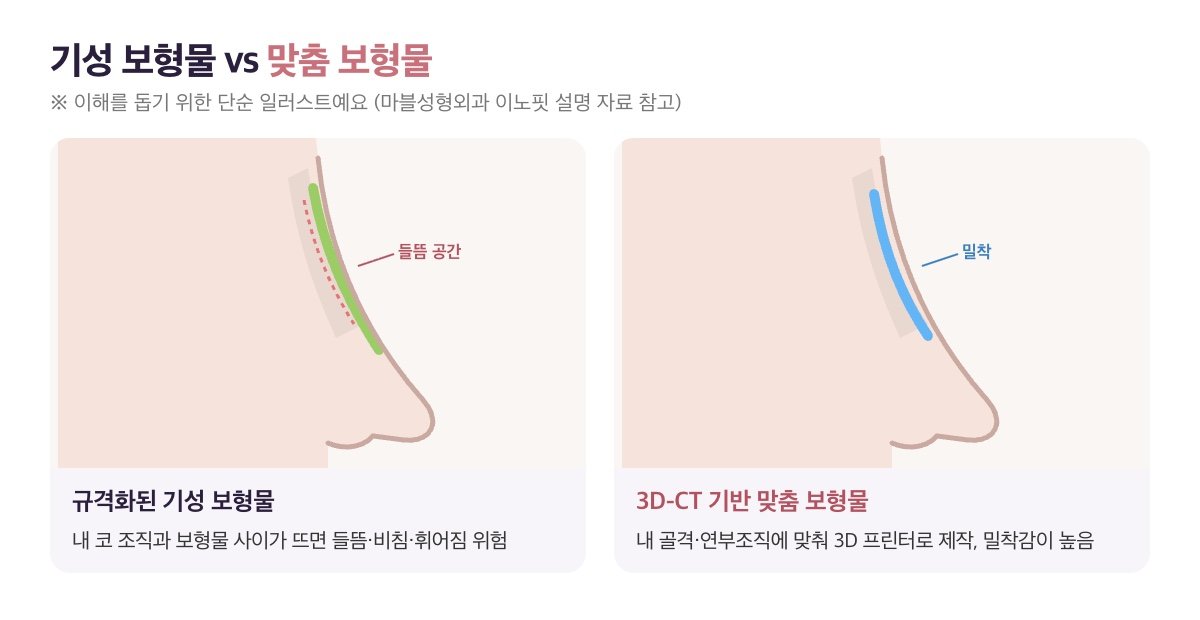
Conventional ready-made implants are standardized products carved by hand during surgery. If the implant does not fit precisely against your nasal bone, problems such as lifting, show-through or bending can occur. Marble Plastic Surgery’s INOFIT custom nose implant, by contrast, is made by recreating bone, cartilage and skin tissue from 3D-CT image data, designing the desired bridge line through virtual surgery, and producing the implant with a 3D printer.
- Analysis of internal nasal tissue with 3D-CT scanning
- Virtual surgery with software to design the ideal nose shape
- In-depth consultation with the surgeon in charge and surgical planning
- Production of the custom implant with a 3D printer
- Surgery with the custom-made implant
This method suits natural-yet-glamorous rhinoplasty well when you want a bridge that is not excessive and sits snugly like your own nose. However, a custom implant is not necessary for everyone, so the decision is made at the consultation based on skin thickness and the desired height.
Autologous cartilage nose tip surgery – a defined yet natural tip
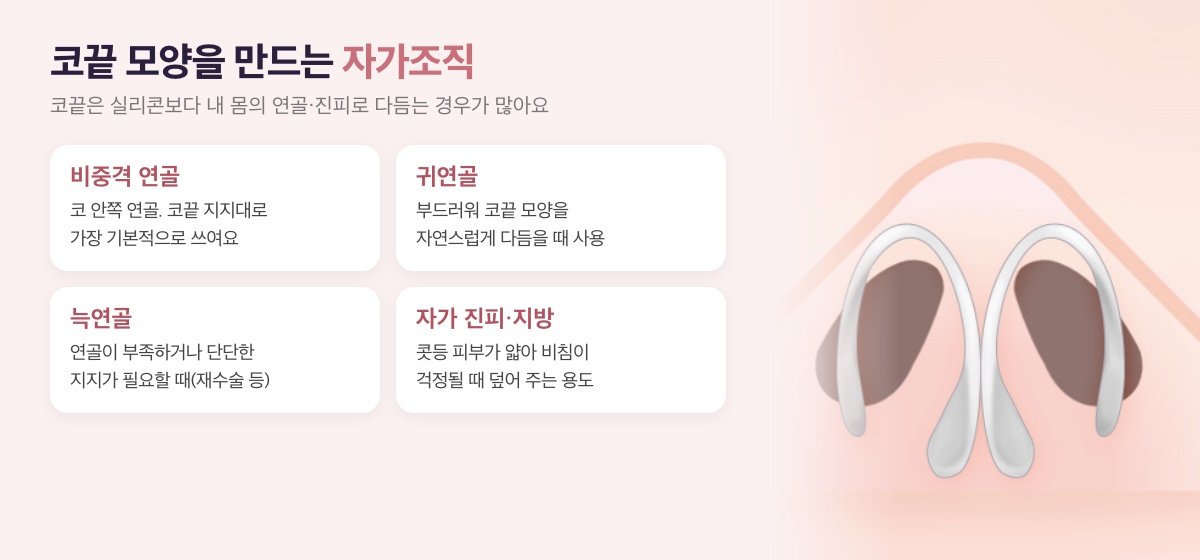
The nose tip has thin skin and moves a lot, so it is often refined with your own cartilage, rather than artificial implants such as silicone. If the tip shape is average, simply tying the spread alar cartilages may be enough; if the tip is low, autologous cartilage or dermis is added. If the tip needs strong support, another layer of cartilage is placed on top of a sturdy cartilage strut.
- Septal cartilage: Cartilage inside the nose, used as the most basic support for the tip.
- Ear (conchal) cartilage: Its soft curves make it useful for shaping the tip naturally.
- Rib (costal) cartilage: Used when ear or septal cartilage is insufficient, or when firm support is needed (such as in revision surgery).
- Autologous dermis / fat: Used as a cover when the skin over the bridge is thin and show-through is a concern.
It is also possible to refine only the tip with cartilage, without a silicone bridge implant – this is called implant-free nose tip surgery. It can be considered for those whose bridge is already fine but who are unhappy with the tip, or who are reluctant to use artificial implants.
Rhinoplasty recovery time and surgery information
| Surgery time | Within about 2 hours |
| Anesthesia | Sedation + local anesthesia |
| Hospital stay | Same-day discharge |
| Follow-up visits | About 2 visits |
| Recovery period | Return to daily life in about 1–2 weeks (tip swelling subsides over several months) |
※ Based on Marble Plastic Surgery’s guidelines for rhinoplasty and nose tip surgery by type; details may vary depending on the scope of surgery.

- Surgery day to day 3: Swelling and bruising are at their worst. Rest with your head elevated and apply cold compresses as instructed by the medical team.
- About 1 week: The splint and stitches are removed, and light daily activities and returning to work become possible.
- Around 2 weeks: Major swelling subsides and makeup becomes possible.
- 1 month: Exercise, saunas and alcohol are resumed gradually after consulting the medical team. Take care that glasses do not put weight on the nose.
- 3–6 months: Residual swelling in the tip subsides and the natural-yet-glamorous line settles in. It is best not to judge the result before this point.
During recovery, avoid blowing your nose hard, sleeping face down or touching your nose often. Complications such as bleeding, infection or inflammation can occur and satisfaction varies from person to person, so contact the clinic right away if you notice any unusual symptoms.
Choosing a rhinoplasty clinic in Gangnam: check these 5 things
Search for rhinoplasty near Gangnam Station or Sinnonhyeon rhinoplasty and you will find so many clinics that it is easy to feel lost. Rather than relying on ad copy, check the five points below in person during your consultation.
- Operating surgeon: Confirm that the board-certified plastic surgeon you consulted performs the surgery personally and that the clinic runs a surgeon-name disclosure (no ghost surgery) system.
- Pre-op examination: Confirm that the design is based on 3D-CT and other tests that look at the internal nasal structure and your breathing.
- Anesthesia and safety system: Confirm that a board-certified anesthesiologist is on site and that intraoperative monitoring and emergency equipment are in place.
- Range of materials: Confirm that they explain the materials that suit your nose, such as implants and septal, ear or rib cartilage.
- Aftercare and revision support: Confirm that they explain in advance how you will be cared for during recovery and how problems will be handled if they arise.
Rhinoplasty near Gangnam & Sinnonhyeon Stations: Marble Plastic Surgery medical team and clinic information
Marble Plastic Surgery is located on Gangnam-daero in Seocho-gu, Seoul, between Gangnam Station and Sinnonhyeon Station, about a 5-minute walk from either station. Besides rhinoplasty, it treats eye, breast, anti-aging, facial contouring and body surgery, and the attending medical team takes responsibility from consultation and surgery through aftercare — surgeon-name disclosure (no ghost surgery) system, under which the assigned medical team takes responsibility from consultation through surgery and aftercare.
Dr. Seo Il-beom, Chief Director (board-certified plastic surgeon)
- Graduate of Seoul National University College of Medicine
- Resident at Samsung Medical Center, board-certified plastic surgeon
- Clinical (adjunct) professor and consulting physician, Department of Plastic Surgery, Samsung Medical Center
- Full member of the Korean Society of Plastic and Reconstructive Surgeons, the Korean Society for Aesthetic Plastic Surgery and the Korean Cleft Palate-Craniofacial Association
- Full member of the Korean Society for Microsurgery, the Korean Society for Surgery of the Hand and the Korean Scalp & Hair Society
- Member of the International Confederation for Plastic, Reconstructive and Aesthetic Surgery (IPRAS)
Safety systems
- Board-certified anesthesiologist on site: Oversees the entire anesthesia process, from pre-operative tests to after surgery.
- Real-time monitoring: A central monitoring system observes patients during surgery and recovery.
- CCTV in the operating room: Increases the transparency of the surgical process and prepares for emergencies.
- Emergency equipment: Equipped for emergencies, including a defibrillator and a self-generating power system.
Marble Plastic Surgery clinic information
📍 Address 3F Juryuseong Building, 435 Gangnam-daero, Seocho-gu, Seoul
🚇 Transportation About a 5-minute walk from Exit 10 of Gangnam Station (Line 2) / about a 5-minute walk from Exits 7 and 8 of Sinnonhyeon Station (Line 9 and Shinbundang Line)
☎️ Phone 02-596-7500
🕘 Hours Weekdays 10:00–19:00 / Saturdays 10:00–16:00
⛔ Closed Sundays and public holidays
Marble Plastic Surgery official channels
Korea consultation & videos
English
Japanese consultation · 日本語相談
Chinese · 中文
Korean rhinoplasty FAQ: Jaryeohan (natural-yet-glamorous) nose surgery
Q. What does Jaryeohan rhinoplasty mean?
It combines the Korean words for “natural” and “glamorous,” and refers to a rhinoplasty design that keeps the bridge natural for your face while giving the tip a crisp accent. It is not a formal surgical name, but a term describing the style of the result.
Q. Can a natural-yet-glamorous nose be achieved without an implant?
If the bridge is already high enough and only the tip needs work, implant-free nose tip surgery that refines only the tip with autologous cartilage such as septal or ear cartilage can create a natural-yet-glamorous look. If the bridge is low, it needs to be enhanced as well with an implant or autologous tissue.
Q. If I bring a celebrity photo, will my nose turn out the same?
Reference photos help convey the mood you want, but if your face length, forehead height and skin thickness differ, the same result is hard to achieve. Use photos to explain “this kind of feel,” and get a design consultation tailored to your own facial proportions.
Q. How long is the rhinoplasty recovery time?
Usually you can return to office work around 1 week, when the splint is removed, and major swelling subsides after about 2 weeks. Tip swelling subsides gradually over 3–6 months, so the final shape is judged after that.
Q. Can a revision rhinoplasty also be changed to a natural-yet-glamorous style?
It depends on the condition of the existing implant, whether there is capsular contracture, and how much cartilage remains. After checking the condition of the previous surgery with 3D-CT, a plan is made using autologous tissue such as rib cartilage if necessary.
Q. What are the possible side effects of rhinoplasty?
Bleeding, infection, inflammation, prolonged swelling, asymmetry, implant visibility or deviation, and capsular contracture can occur. A thorough pre-op examination, choosing materials that suit your nose, and following the care rules during recovery help reduce the risks, and it is best to contact the clinic right away if you notice any unusual symptoms.
Q. How should I choose a rhinoplasty clinic in Gangnam?
Rather than looking only at reviews or prices, compare whether a board-certified plastic surgeon operates personally, pre-op tests such as 3D-CT, safety systems such as an on-site anesthesiologist, and how revisions and aftercare are handled. Getting consultations at two or three clinics and comparing whether the design explanation fits your face is also a good approach.
Q. Can I have surgery if I have rhinitis or nasal congestion?
Yes. If there is a cause that interferes with breathing, such as a deviated septum or turbinate hypertrophy, aesthetic correction and functional correction can be planned together. It is important to identify the cause first through pre-operative tests.
Closing – a Jaryeohan nose is perfected by a sense of restraint
The key to natural rhinoplasty is not simply making the nose higher and sharper, but adding only as much as your face needs and giving the tip a refined accent. If you are considering Korean rhinoplasty, check your nose type, breathing and skin thickness carefully at the consultation along with the mood you want. A design that starts from precise analysis leads to a result that looks natural for years to come.
※ This article is written to provide general medical information, and surgical methods and progress may vary depending on individual conditions. Whether and how to have surgery must be decided after an examination by a specialist. All surgery can involve side effects such as bleeding, infection, inflammation and asymmetry, and satisfaction with the results varies from person to person.
Discover more from Korea Doctor Interview
Subscribe to get the latest posts sent to your email.