
Daegu Hairline Hair Transplant: 10 Q&A|Wide Forehead, M-Shaped Forehead and Female Hair Transplant Guide (The Black Plastic Surgery)

Do you hesitate to go out unless your bangs are down, and is a wide forehead or the receding M-shaped sides the first thing you notice in every photo? Because of concerns like these, a steadily growing number of people are looking into Daegu hairline hair transplantas an option. Many consultations also come from people in their 20s and 30s whose hair loss is not severe, as well as from women.
But the hairline changes the impression of your face right away, so there are many questions: “How far down can it go?”, “Will it look obvious?”, “How is it different from forehead reduction surgery?” So in this post, we picked 10 questions that actually come up often in consultations and answered them one by one, based on clinical materials from The Black Plastic Surgerynear Banwoldang Station in Daegu.
✔ 30-second summary
A Daegu hairline hair transplant is surgery that moves healthy follicles from the back of the head to create a new forehead line. The height is set based on the vertical facial proportion of 1:1:1, and finer follicles are placed toward the front using 4-step gradationgrafting so the border looks natural. Transplanted hair usually starts to grow from about 3–4 months.
Q1. How is a hairline hair transplant different from forehead reduction surgery?
Both make the forehead look smaller, but they work on different principles.
| Category | hairline hair transplant | Forehead reduction surgery |
|---|---|---|
| Principle | Follicles from the back of the head are planted along the forehead to create a new line | Forehead skin is removed and the scalp is pulled forward and sutured |
| Line shape | Can be designed into the desired shape, such as a curve or M-shape correction | The existing hairline shape moves down almost unchanged |
| Scar | No incision scar on the forehead | An incision line forms along the hairline |
| When results appear | Gradually, from 3–4 months as the hair grows | Right after surgery |
| Best suited for | M-shaped or square foreheads, when you want to change the shape of the line | When the line shape is fine and you only want to lower it significantly |
If you want to fill in the receding M-shaped areas or round off angular corners, a hair transplant is the better fit. Which method suits you should be decided after examining your scalp elasticity and forehead height in person.
Q2. Is my forehead a candidate for a hairline hair transplant?
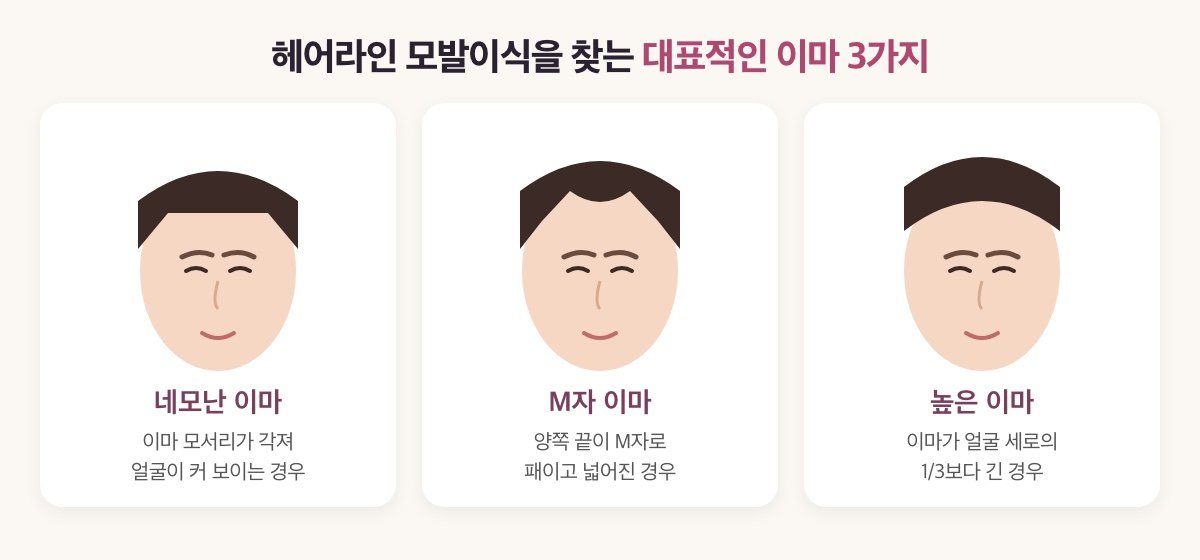
The Black Plastic Surgery groups hairline concerns into three main forehead types during consultation.
- Square forehead: The corners of the forehead are angular and the space between the brow tail and the forehead corner is wide, making the face look larger
- M-shaped forehead: Both sides of the forehead recede into an M-shape and look wide. This may also be an early sign of male pattern hair loss.
- High forehead: The forehead looks longer than 1/3 of the face’s vertical length
All three types can be corrected with a hair transplant, but if an M-shaped forehead is caused by hair loss, it is best to plan treatment that slows hair loss alongside the transplant.
Q3. How much can the forehead be lowered?
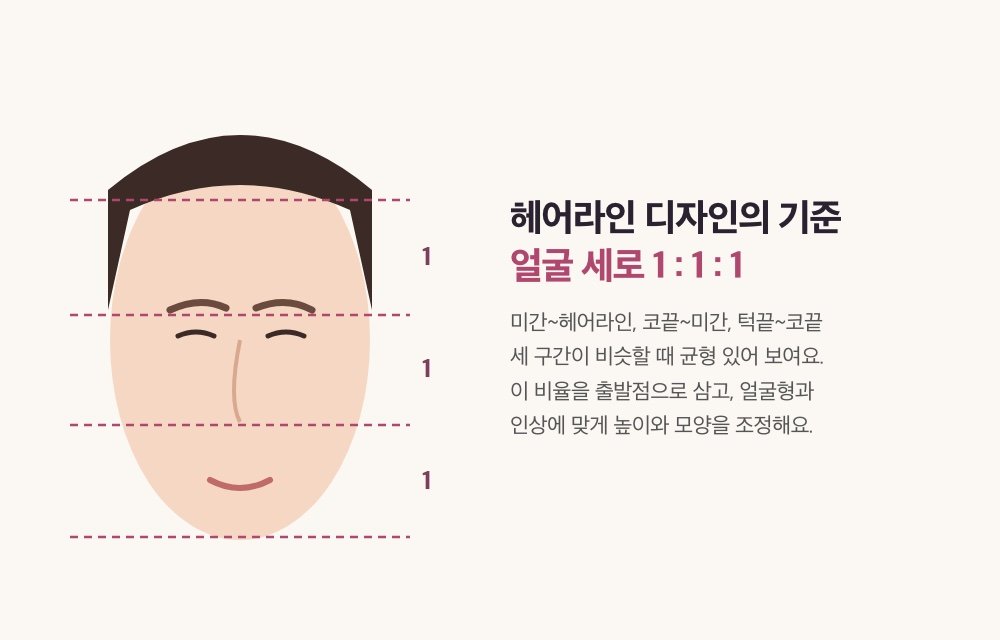
The hairline height is not set by “as much as possible” but according to your facial proportions. As a starting point, the clinic uses the guideline that a face looks balanced when the lengths of glabella to hairline, nose tip to glabella, and chin tip to nose tipare close to 1:1:1.
However, the same numbers are not applied to every face. The height and curve of the line are adjusted to face shape, forehead contour, brow position and usual hairstyle. It is also important not to set the line too low, considering the possibility of future hair loss. If the line is lowered too much, it can look unnatural later in life when the hair behind it thins.
Q4. How is it planted so it doesn’t look obvious?
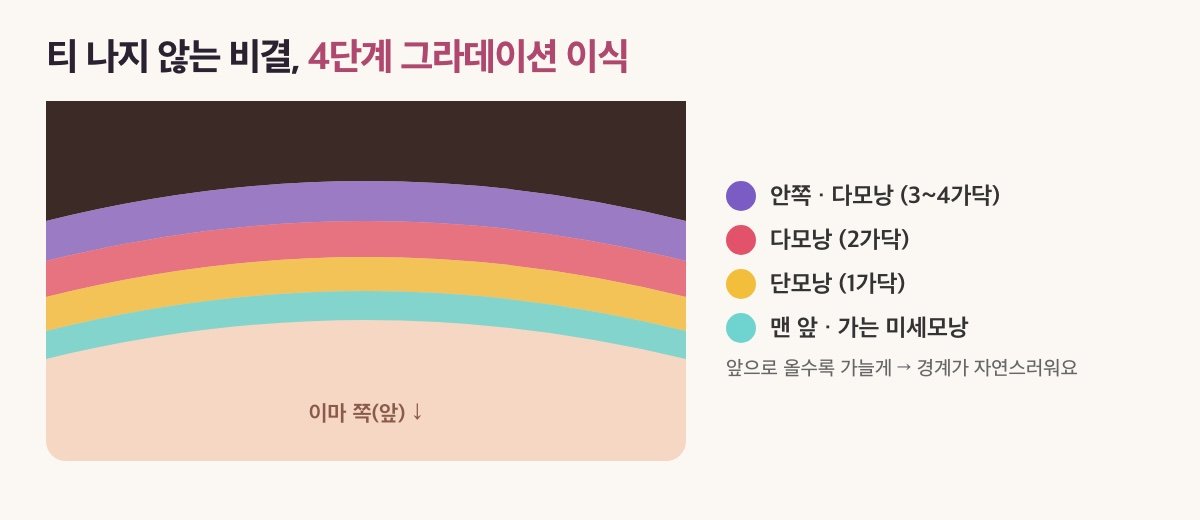
The key to a natural hairline is how follicles are arranged by thickness. A natural forehead line has thin, short baby hairs at the very front, with hair becoming thicker and denser further back. If thick follicles are planted in a single row at the front without following this flow, the result looks “transplanted.”
The Black Plastic Surgery arranges follicles from the front inward in the order of fine single-hair grafts (1 thin hair) → single-hair grafts (1 hair) → multi-hair grafts (2 hairs) → multi-hair grafts (3–4 hairs), applying 4-step gradation grafting. The direction and angle of hair growth and even the degree of curl must also be matched so the border doesn’t show even when you sweep your bangs back.
Q5. Is a hairline done with non-incision or incision?
Hairline correction often involves a relatively small grafting area, so many people choose non-incision (FUE). The back of the head is trimmed short and only the needed follicles are selectively harvested with a punch about 1 mm in diameter, which makes it easier to select fine follicles and allows relatively fast recovery.
On the other hand, if the forehead is very wide or the M-shaped areas and crown both need filling, requiring a large number of grafts, the incision method may be more suitable. The differences between the two methods are compared in detail in the post How to Choose a Good Hair Transplant Clinic in Daegu|Non-Incision vs. Incision Guide for further reading.
Q6. Can women get a hairline hair transplant too?

Yes, it is possible. In fact, many women come in for consultations because of a wide or M-shaped forehead. However, women’s hair loss patterns differ from men’s, so identifying the cause firstis an important step. The clinic mainly looks at the following four causes of female hair loss.
- Stress and excessive dieting
- UV exposure, frequent perms and coloring
- Pregnancy and childbirth
- Hormonal changes
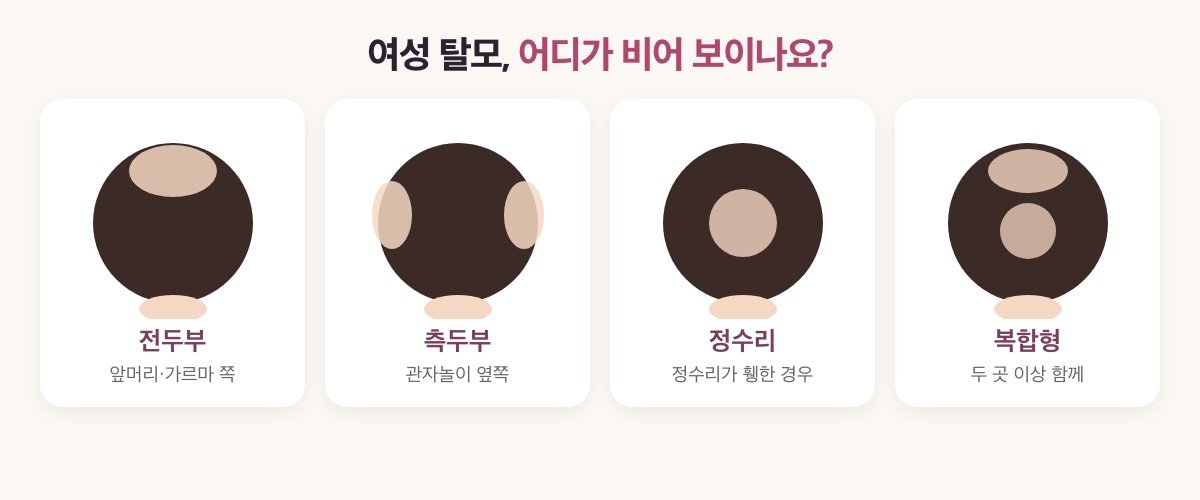
The areas of hair loss are also divided into frontal (bangs and part line), temporal (temples), crown, and combinedtypes. Since the part area often thins while the hairline stays relatively intact, the consultation also checks whether density reinforcement is needed along with the hairline design.
Q7. Does the surgery hurt? How long does it take?
The surgery is performed under local anesthesia. There is a stinging sensation at the beginning when the anesthetic is injected, and in most cases the procedure proceeds without significant pain afterward. Surgery time depends on the number of follicles and the harvesting method (non-incision or incision), so it is best to ask about it during consultation along with the estimated number of grafts. You can go home the same day, and resting with your upper body slightly raised on the day of surgery helps manage swelling.
Q8. When does it start to look natural?
A hairline hair transplant does not show results immediately. The typical course is as follows.
- 2 weeks after surgery: Scabs form on the grafted area and then fall off. During this period, the most important thing is not to pick or scratch the scabs.
- 4–6 weeks: This is when the transplanted hair temporarily falls out. The follicles remain, so there is no need to worry.
- 3–4 months: New hair begins to grow again.
- 6 months – 1 year: As the hair grows thicker and longer, the line gradually settles in naturally.
Since you may need a period when you can cover the area with bangs, if you have important events coming up, it is best to schedule the surgery with plenty of time to spare.
Q9. How should I care for it after surgery?
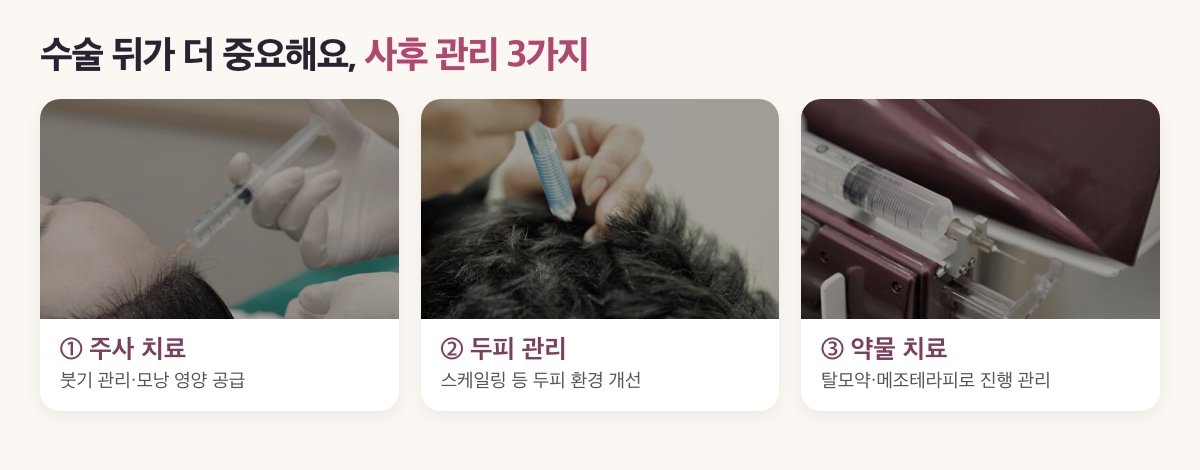
The Black Plastic Surgery does not see a hair transplant as ending with surgery; it treats aftercare as part of one continuous process.
- Injection therapy: Growth factors are injected to manage swelling and support nutrition and blood circulation to the follicles.
- Scalp care: Scalp problems that worsen hair loss are managed with treatments such as scaling.
- Medication: Approved hair loss medication and mesotherapy are used to manage the progression of hair loss in existing hair.
Especially if an M-shaped forehead is caused by hair loss, the existing hair that was not transplanted may keep thinning, so consistent care helps maintain the results longer.
Q10. If surgery still feels like too much, are there other options?
If hair loss has only just started, non-surgical treatment can be considered before surgery. For early hair loss, prevention of hair loss progression and improvement of seborrheic scalp dermatitis, The Black Plastic Surgery also runs a non-surgical hair loss injection program (Follicle Strengthening Program). However, non-surgical treatment cannot create new hair in areas where follicles have already disappeared, so if you want to change the line itself, it is a good idea to also get a hair transplant consultation.
Daegu hairline hair transplant pre-consultation checklist
☐ Clarify whether your concern is “forehead height” or “line shape (M-shape, angular corners)”
☐ Prepare photos of your usual hairstyle, whether you wear your bangs down or swept back
☐ Check whether anyone in your family has hair loss and whether your hair has recently become thinner
☐ Bring a list of the medications and supplements you take
☐ Ask specifically about the estimated number of grafts, surgical method and design height
☐ Confirm the aftercare plan as well (injections, scalp care, medication)
The Black Plastic Surgery clinic information
| Clinic name | The Black Plastic Surgery Clinic (Chief Director Dr. Shin Dong-pil) |
| Treatment areas | Hairline, male and female hair transplants, eyebrow and eyelash transplants, atrichia, non-surgical hair loss treatment |
| Address | 3rd and 4th floors, Yemian Tower, 2118 Dalgubeol-daero, Jung-gu, Daegu |
| Transportation | Banwoldang Station Exit 7, Daegu Subway Line 2 |
| Phone | 053-426-4700 |
| Clinic hours | Mon & Wed 09:00–19:00 / Tue & Fri 09:00–18:00 / Sat 09:00–17:00 Closed on Thursdays, Sundays and public holidays |
See consultation information on The Black Plastic Surgery website
Final thoughts – A hairline is about “design” more than “height”
If you are considering a hairline hair transplant in Daegu, think first not about how many centimeters to lower it, but about how naturally a line that fits your facial proportions can be created. Making your decision after hearing a concrete explanation of the design criteria, follicle arrangement method and aftercare plan during consultation is the way to a choice you won’t regret.
※ This article was written to provide general medical information. Surgical methods and progress may vary depending on each individual’s scalp condition and degree of hair loss. Be sure to decide whether to have surgery, and which method, after an examination by a specialist. All surgery carries possible side effects, including bleeding, infection, swelling and individual differences in graft survival.
Discover more from Korea Doctor Interview
Subscribe to get the latest posts sent to your email.