
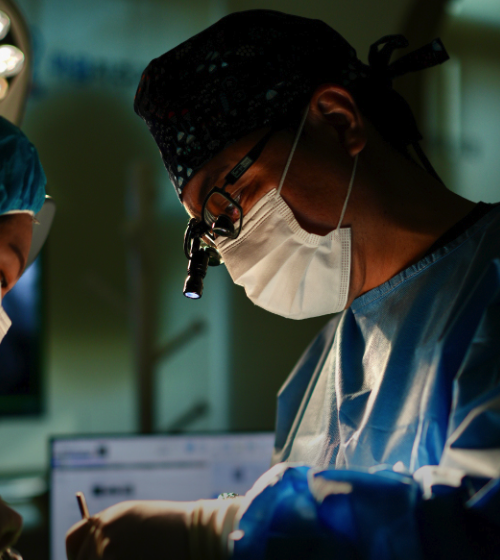

Interview with Dr. Yoonsang Kim, Former Director of Wonkwang University Dental Hospital, Now at Maeum Periodontal Dental Clinic –
Partial dentures and dental implants are the treatments middle‑aged patients worry about the most.
When teeth are lost, it affects not only daily comfort but also eating, speech, and aesthetics, making treatment choices naturally more cautious. Yet even after choosing a treatment, many patients still wonder, “How can I take care of it so it lasts longer?”
In this interview, we spoke with Dr. Yoonsang Kim—former Director of Wonkwang University Dental Hospital and a periodontics specialist at Maeum Periodontal Dental Clinic—about partial denture and implant care, exploring real clinical cases together.

Why does discomfort occur when using partial dentures?
The issue isn’t the denture itself — the key is managing the abutment teeth.
A partial denture is supported and stabilized by the remaining natural teeth. This means the abutment teeth must stay healthy for the denture to function properly. However, many patients stop visiting the dentist after receiving their denture, assuming that everything is fine simply because they can use it.
✔ Case 1: “My denture has become loose”
A woman in her 60s had not visited a dentist for two years after receiving her partial denture. Although it fit well at first, it gradually became loose and began shifting while chewing, causing discomfort and prompting her to return for treatment. Examination revealed inflammation around the abutment tooth and significant bone loss. As the abutment tooth became mobile, the denture could no longer function properly. The issue was not the denture itself but the failure to maintain the abutment tooth.
Dr. Yoonsang Kim stated, “A significant number of partial denture patients suffer from inflammation around the abutment teeth,” and…
He emphasized that the issue lies not in the denture itself, but in the lack of proper abutment tooth care in most cases.
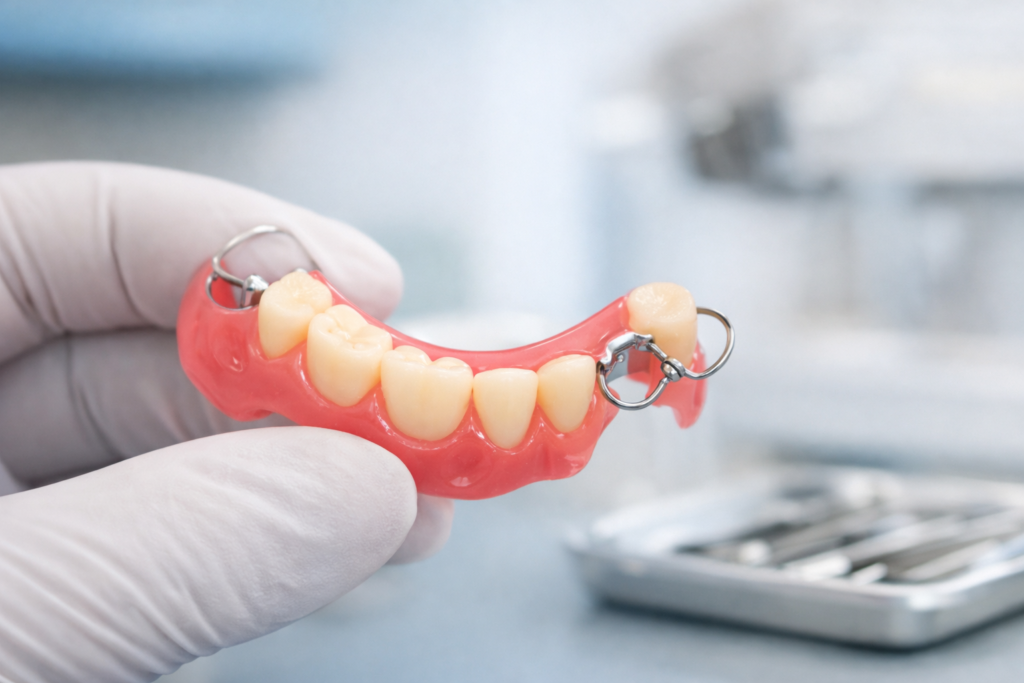
Why is it difficult for partial denture users to maintain their natural teeth? Why self‑care often leaves blind spots
Patients who use partial dentures often ask, “Isn’t diligent home care enough?”
However, in reality, no matter how diligently patients care for their teeth at home, there are always areas they miss. This is because the care required differs between areas with natural teeth, areas without teeth, areas with prosthetics, and the parts where the denture makes contact. In particular, the area around the abutment tooth easily accumulates bacteria, and due to the structure of the denture, many spots are difficult for a toothbrush to reach, making inflammation more likely.
✔ Case 2: “I brushed diligently, so why did inflammation occur?”
A man in his 70s brushed his teeth three times a day and cleaned his denture daily, yet he developed severe inflammation around the abutment tooth and came to the clinic. Although he believed he was “taking good care of it,” the narrow space between the denture and the abutment tooth is extremely difficult to clean on one’s own. Without learning proper professional care techniques, he unintentionally missed critical areas. Ultimately, regular dental visits are essential to learn personalized care methods and to have missed areas checked.
How often should you visit the dentist? Dentures and natural teeth require different maintenance intervals
Because dentures rest on the gum bone, changes in the bone structure with age can cause them to no longer fit properly. Therefore, it is recommended to have dentures checked every six months. Natural teeth, however, are always at risk of bacterial infection and require more frequent care. If inflammation is present, follow‑up care every 2–4 weeks after treatment is necessary. Once proper care techniques are learned, regular check‑ups every 3–6 months are appropriate.
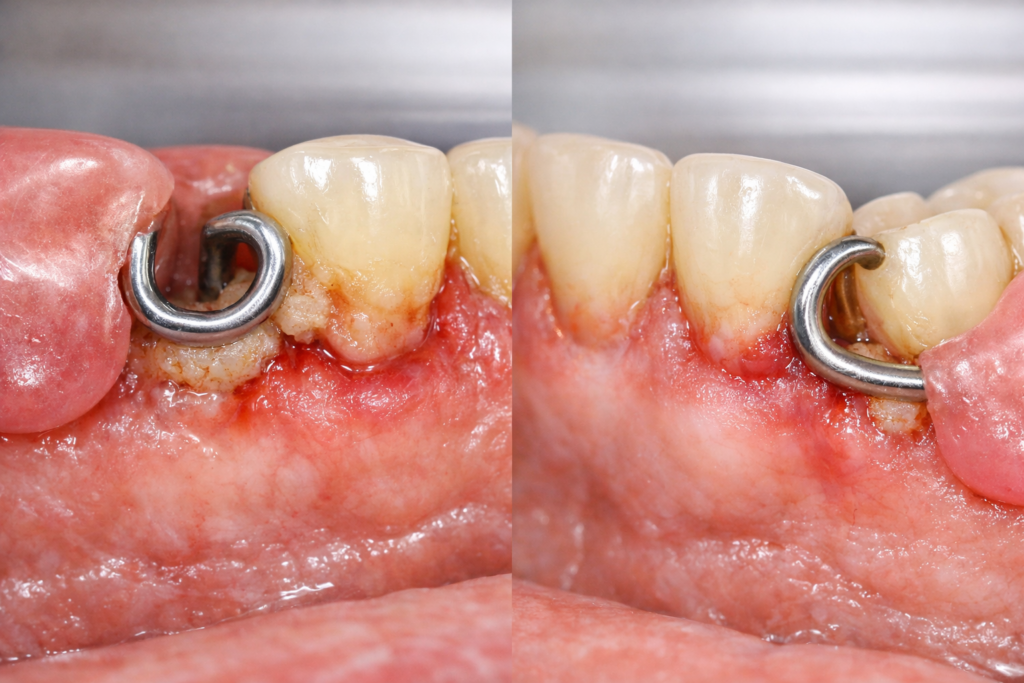
✔ Case 3: “I didn’t come for over a year, and my teeth have deteriorated a lot”
A woman in her 50s postponed her dental visits for over a year due to a busy lifestyle. She believed her denture fit well, but a detailed examination revealed significant bone loss around the abutment tooth, along with gum swelling and progressing inflammation. It was a problem that could have been treated early if she had attended regular check‑ups.
Why do complications occur after dental implant surgery?
Inflammation progresses more rapidly because its structure differs from that of natural teeth
Dental implants are a highly effective treatment that can replace natural teeth, but because their structure differs from that of natural teeth, complications can occur. The spaces around implants tend to be larger than those around natural teeth, and if bacterial infection develops, inflammation progresses more rapidly than it does with natural teeth.
✔ Case 4: “I never felt any pain, but they said a lot of bone has been lost”
A man in his 60s had dental implants placed five years earlier, but because he felt no pain, he did not visit the dentist. One day, his gums suddenly became swollen and started bleeding, so he came to the clinic. By then, a significant amount of bone around the implant had already been lost. Unlike natural teeth, implants do not produce early pain signals, so patients often remain unaware of problems until the condition becomes severe.
To maintain implants long‑term, regular X‑rays and mastering personalized care methods are essential
X‑rays allow us to check changes in bone height, alterations in the implant structure, and the stability of the implant. They also help detect early inflammation that is not visible on the surface.
In addition, implant care varies depending on its position, shape, and the condition of the surrounding gums, so it is important to learn the proper, personalized care method from your dentist.
✔ Case 5: “My problems only decreased after I learned the proper care methods”
A man in his 50s frequently experienced gum swelling after receiving dental implants, but after attending regular check‑ups and learning care methods tailored to the structure of his implants, his symptoms significantly decreased. This case shows that simply brushing well is not enough—customized care that matches the implant’s structure is essential.
For both dentures and implants, proper maintenance is the final step that completes the treatment
Whether it’s a partial denture or an implant, inadequate post‑treatment care eventually leads to gum disease and the need for retreatment. Implants are especially risky because problems can progress to a severe stage without causing pain. Regular dental visits and learning the correct care methods are what truly complete the treatment. Treatment is only the beginning—maintenance must continue for life.

Regular dental visits and mastering proper care methods are an extension of treatment and the most reliable way to protect oral health for life.
If you are currently using dentures or implants, it’s time to re‑evaluate your care habits starting today.
And a little attention and consistent care will determine the next 10 or 20 years.
Maum Periodontal Dental Clinic Website https://maumperio.com
Discover more from Korea Doctor Interview
Subscribe to get the latest posts sent to your email.


