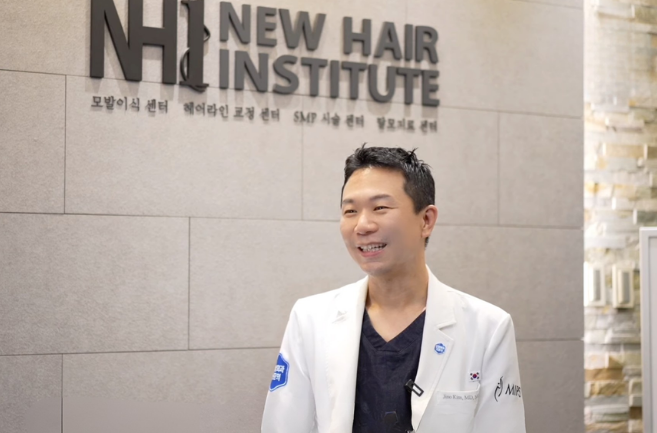

🟩 Interview with Dr. Jino Kim of Gangnam New Hair Transplant Clinic: What’s the difference between the strip method and the FUE method?
When people considering a hair transplant visit the clinic, there is one question they always ask first.
“What's the difference between the strip method and the FUE method?”
“People say the FUE method is safer, more natural, and less painful… is that true?”
This question isn’t just simple curiosity — it carries the fear, anxiety, worry, regret, and the strong desire not to fail again, felt only by those who have experienced hair transplantation at least once.
Dr. Jino Kim of Gangnam New Hair Transplant Clinic understands the feelings of these patients better than anyone, and…
To ease that fear, he clearly explained the fundamental differences between the strip method and the FUE method.

🟩 Strip Method vs FUE Hair Transplant
Dr. Jino Kim jokingly said, “The person who came up with the term ‘FUE’ deserves an award from the hair transplant society.”
Because the term “non‑incisional” itself gives people a tremendous sense of psychological reassurance.
- It feels like no scalpel will be used, and…
- It feels like there won’t be any scarring, and…
- It feels like there will be less pain, and…
- It feels like the recovery will be faster, and…
- It feels like there will be less burden, and…
It naturally creates this kind of image.
But in reality, in other countries…
- 절개법 = Strip Method
- The non‑incisional method is called FUE (Follicular Unit Excision).
✨ If it had been translated literally in Korea as Strip Surgery vs Follicular Unit Excision, then…
The non‑incisional method would not have been chosen as overwhelmingly as it is now.
🟩 The actual process of the Strip Method: Why a strip of skin is removed
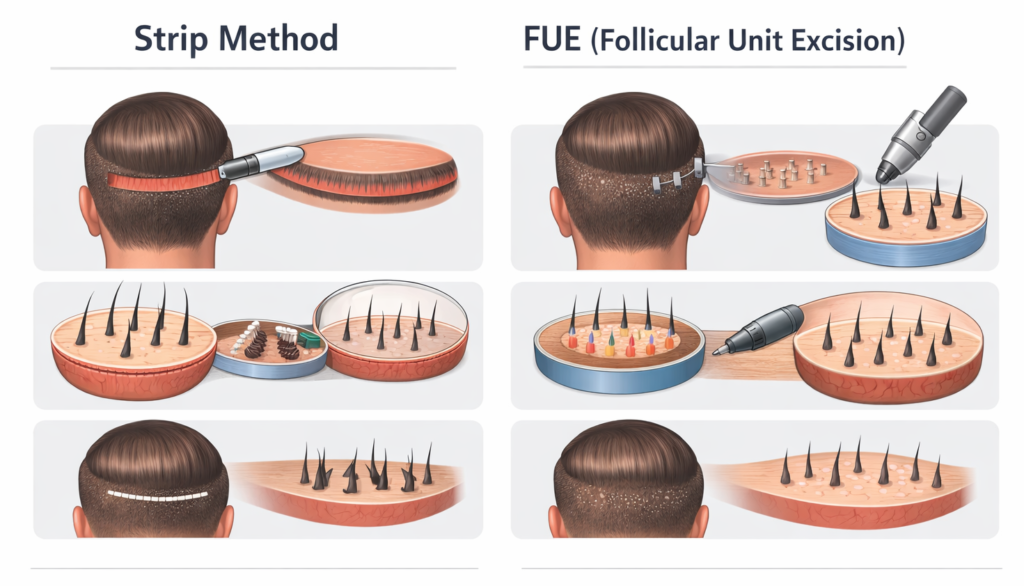
The strip method involves excising a strip of skin from the back of the scalp.
The width is usually about 1 to 1.5 cm, and for those with good scalp elasticity, it can go up to 2 cm.
The excised skin is then placed under a microscope…
- one follicular unit
- two follicular units
- three follicular units
They are precisely separated into these units.
After that, these follicular units are implanted one by one into the small recipient sites that have been created.
The incision site is neatly closed with sutures, and over time, a thin linear scar may remain.
However, when a skilled surgeon performs the suturing, the scar heals to become very thin and natural-looking.
🟩 Actual process of the FUE method: the technique of extracting follicular units one by one
The non‑incisional method uses a small cylindrical punch tool to extract follicular units one by one.
It operates on a principle similar to the rotary instruments used in dentistry, making a circular incision around the follicle and then extracting it whole.
The wounds left after extraction are very small—about 1 mm—and heal naturally, so no sutures are required.
Because of this, it is called the “non‑incisional method,” but in reality, it is more accurate to view it as a technique involving repeated very small incisions.

🟩 Advantages of the strip method: securing ample tissue around the follicular units
The greatest advantage of the strip method is that it allows ample preservation of the tissue surrounding the follicular units.
The tissue surrounding the follicle functions much like soil does for a tree.
- moisture retention
- nutrient supply
- protection from external impact
- stabilization of follicle survival rate
All of these factors depend on the tissue surrounding the follicle.
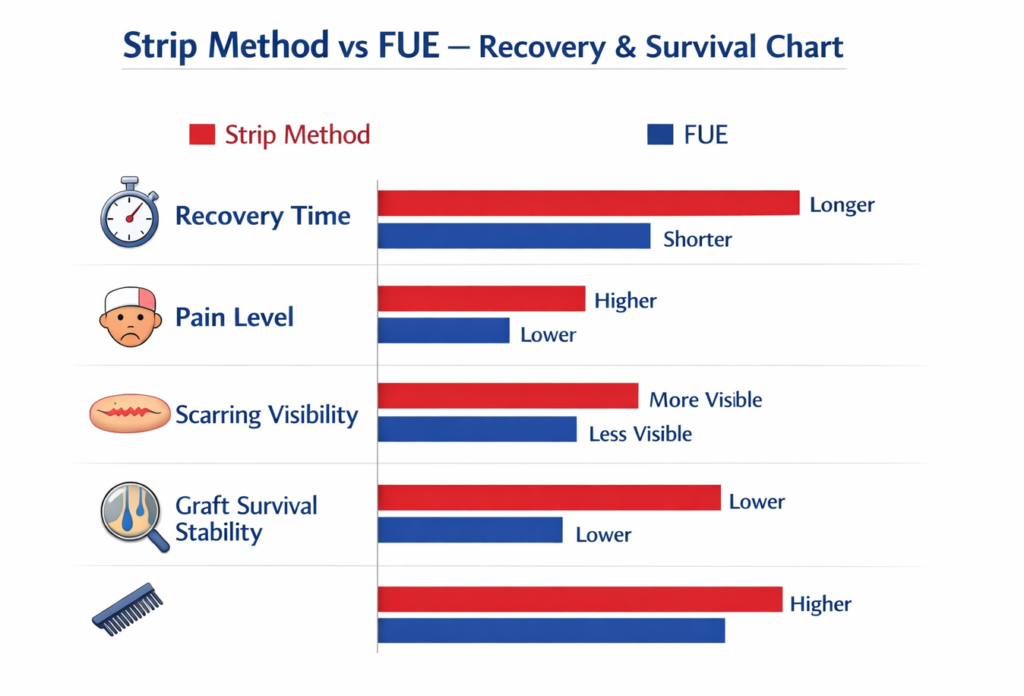
Therefore, the strip method can offer a somewhat more stable graft survival rate.
🟩 Disadvantages of the strip method: suturing and linear scarring
- requires suturing
- leaves a linear scar
- may be disadvantageous for very short hairstyles
However, when sutured by a skilled surgeon, the scar heals very thin and naturally, and
It is not a significant issue for most patients.
🟩 Advantages of the non‑incisional method: faster recovery and less pain
The advantages of the non‑incisional method are as follows.
- no suturing is required
- recovery is fast
- there is less pain
- looks natural even with short hairstyles
Especially, the psychological reassurance of “not using a scalpel” is very significant.
🟩 Disadvantages of the non‑incisional method: insufficient tissue around the follicle
In the non‑incisional method, less surrounding tissue is secured around the follicle.
In other words, it becomes similar to a tree with its roots exposed.
- it is difficult to retain moisture, and
- nutrient supply is limited, and
- it is vulnerable to external impact, and
- The outcome can vary greatly depending on the surgeon’s skill level.
Therefore, the non‑incisional method requires more meticulous care and a higher level of skill.
🟩 Incisional vs. non‑incisional method, which is better?
There is no single correct answer.
What matters is choosing the method that best suits the patient.
- If scarring is not a major concern and securing stable follicular tissue is important → Incisional method
- If you prefer quick recovery, short hairstyles, and want to minimize scarring → Non‑incisional method
And above all, what matters most is who performs the surgery.
New Hair Hair Transplant Clinic Website https://newhairps.com
📌 Since 2009, Gangnam New Hair Transplant Clinic has been deeply dedicated to researching only the field of hair transplantation, and
It is a specialized clinic that has accumulated experience from thousands of surgical cases.
Director Jin‑Oh Kim
- Activities in international hair transplantation societies
- Follicular unit research
- Development of Korean‑style non‑incisional techniques
- Hairline design research
Through these achievements, he has earned high recognition both domestically and internationally, and thoroughly analyzes each patient’s scalp condition, hair thickness, degree of hair loss progression, and scarring tendency to…
We recommend the most suitable surgical method.
While upholding the principles of “accurate diagnosis, honest explanation, balanced design, and natural results,”
We consider it our highest value to help patients avoid ever experiencing failure again.
💬 FAQ
1. Are the scars from the strip method very noticeable?
If a skilled surgeon performs the suturing, the scar heals very thin and naturally, and for most patients it does not become a significant issue.
2. Is the non‑incisional method truly incision‑free?
It is not completely free of incisions. It involves multiple small circular punches, but they are so tiny that sutures are not required.
3. Which method provides a more natural result?
Both methods can produce natural results. The key lies in the surgeon’s skill and the ability to place follicular units effectively.
4. Which method offers a faster recovery?
Generally, the non‑incisional method offers slightly faster recovery. However, the actual speed can vary depending on each individual’s skin condition.
5. How much pain should I expect after a hair transplant?
The strip method may cause some tension around the sutured area, while the non‑incisional method may involve mild discomfort. However, neither typically interferes significantly with daily activities.
💡 It’s not about which method—incisional or non‑incisional—is “better,” but rather
Finding the method that suits you best is what matters most.
I hope this article has helped you better understand the differences between the incisional and non‑incisional methods.
• • • • • • • • • • • • • • • • • • • • • • • • • • • • • • • • • • • • • • • • • • • • • • • • • • • • • • • • • • • •
Discover more from Korea Doctor Interview
Subscribe to get the latest posts sent to your email.