

Is fat suction the answer for sagging cheeks? Solutions explained by Dr. Hyuncheol Kim of Gangnam Kidari Plastic Surgery

We recently conducted an in‑depth interview with Dr. Hyuncheol Kim of Gangnam Kidari Plastic Surgery about cheek sagging.
As we age, the first area where many people notice changes is the cheeks. Looking in the mirror, they often wonder, “Why do my cheeks look so saggy!” “Why do they feel so heavy?”
Many people wondered whether they should get fat grafting, receive fillers, or remove deep‑cheek fat to solve their sagging cheeks.
Through the interview, Dr. Hyuncheol Kim corrected misconceptions and misinformation about cheek‑sagging surgery and explained the proper solutions.
🔍 Based on that information, we have summarized the details about cheek‑sagging surgery.
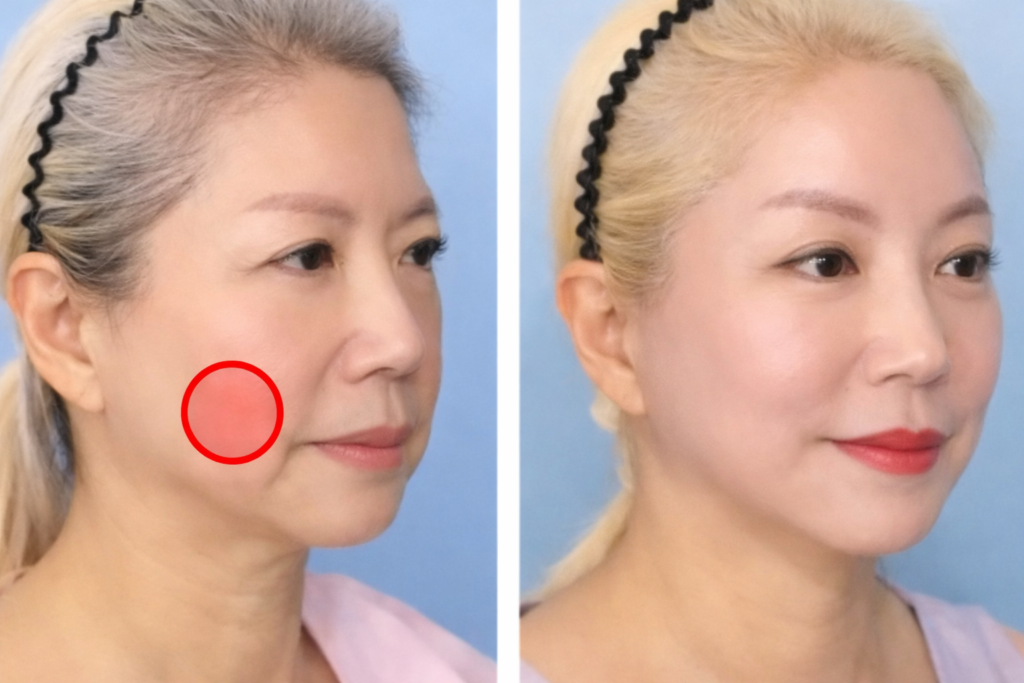
✅ As cheek sagging worsens with age, why do people start considering cheek‑lifting surgery?
Sagging cheeks are not simply caused by loose skin. It is a structural issue that occurs when the deep‑cheek fat located deep inside the face shifts downward due to gravity.
When this fat moves out of its original position and shifts downward Malar hollowing (under‑cheek depression)…and this creates a downward‑pulling force, resulting in marionette lines, deeper nasolabial folds, and sagging along the jawline.
In other words, sagging cheeks are not a problem of skin elasticity but a problem of fat positioning, and this is why many people begin to consider cheek‑lifting surgery.
✅ The position of deep‑cheek fat and the structural causes of cheek sagging
- Right below the cheekbone
- A soft, pouch‑like cluster of fat
- Located close to the bone near the root of the canine tooth
- Located right next to the muscle that lifts the corner of the mouth
This deep‑cheek fat in the face… 45‑degree contour line (front cheekbone line)…it is a key element in creating this contour. This fat plays a crucial role in making the face look attractive and three‑dimensional.
When this fat sags, it leads to cheek drooping, and eventually many people seek cheek‑lifting surgery.
✅ Why you should not choose liposuction for cheek‑sagging surgery
In some clinics, as part of cheek‑sagging surgery…
They were recommending “deep‑cheek fat liposuction.” However, this is a method that should absolutely never be done.
The reason is,
- Deep‑cheek fat is enclosed in a fixed pocket, making it difficult to remove through liposuction.
- Even if it is removed, it disrupts the structural balance of the face.
- It’s a misguided approach that removes volume instead of addressing the actual cause of cheek sagging.
In other words, in cheek‑sagging surgery, liposuction is not a solution — it actually creates more problems.

✅ Facial contour collapse caused by removing deep‑cheek fat
- The cheeks sink inward, creating a hollow and aged appearance.
- The 45‑degree facial contour collapses.
- The edge line where the front and side of the face meet becomes flattened, making the face look wider.
- The facial definition disappears, making you look older.
In other words, if you remove deep‑cheek fat during cheek‑sagging surgery, it actually makes the sagging look even worse.
✅ The real solution for cheek‑sagging surgery: Midface lift
If the deep‑cheek fat has sagged, the best solution is a midface lift.
- Lifting the sagging deep‑cheek fat back to its original position
- And, if necessary, slightly reposition it upward and inward
- A method that naturally restores volume above the nasolabial folds
In other words, the key to cheek‑sagging surgery is not removing fat, but restoring it to its proper position.
Deep‑cheek fat is a key element that creates the three‑dimensional contours of the face.
Especially the rounded fullness of the anterior cheek seen at a 45‑degree angle — it’s a key feature that makes the face look younger and more attractive.
If this fat is removed, there is no remaining tissue to lift, so even with Endotine or other fixation devices, you cannot create the desired contour.
In other words, the most important principle in cheek‑sagging surgery is preserving the deep‑cheek fat.
✅ Supplementary cheek‑sagging surgery for cases where deep‑cheek fat has already been removed
If the deep‑cheek fat has already been removed, you can lift the tissues as much as possible with a midface lift and then restore the missing volume with fillers.
Because fat grafting has unpredictable absorption, fillers are a more reliable option when the goal is to supplement cheek‑sagging surgery.
To avoid going through all of this in the first place, it’s best to avoid cheek‑sagging surgeries that remove deep‑cheek fat.
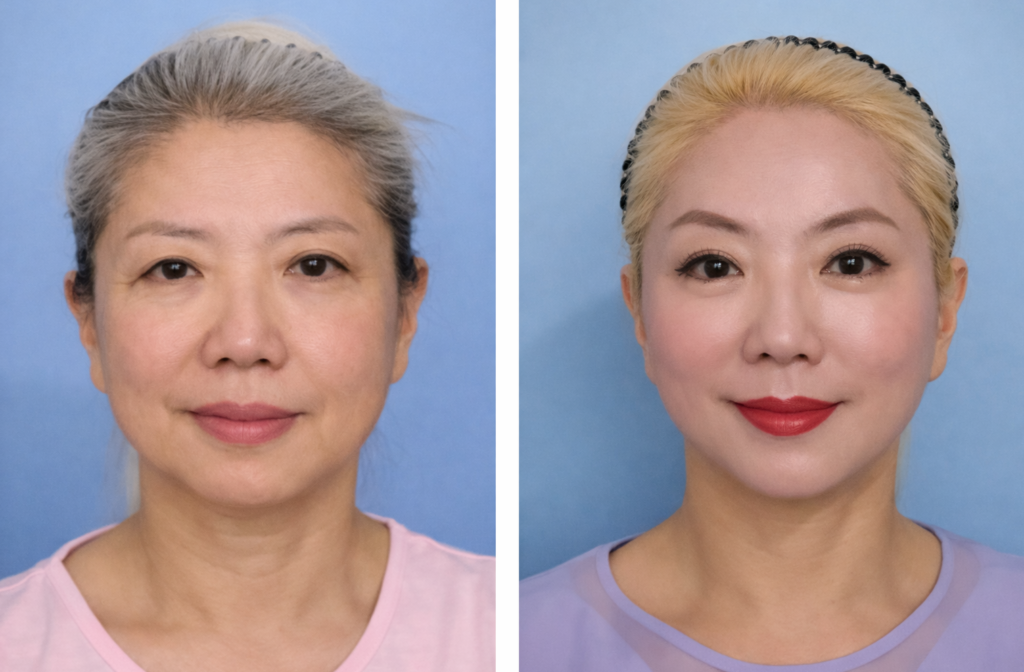
✅ The key to cheek‑sagging surgery is structural restoration.
Cheek sagging is not just a superficial issue caused by loose skin. It is a structural change that occurs when the deep‑cheek fat loses its original position and shifts downward from deep within the face.
Therefore, the key to cheek‑sagging surgery is not removing fat, but lifting the displaced fat back into its proper position to restore the face’s original structure.
Many people considering cheek‑sagging surgery think, “If I remove the fat, won’t it sag less because it becomes lighter?” But this approach actually reduces facial volume, collapses the 45‑degree contour line, and ultimately makes the face look older.
- Deep‑cheek fat is something that should never be removed.
- The cause of cheek sagging is not an ‘excess’ of fat, but the ‘downward displacement’ of fat.
- The most natural and fundamental solution is a midface lift.
- To preserve the face’s volume and contour, fat must be preserved, lifted, and restored to its proper position.
Ultimately, cheek‑sagging surgery is not just about fixing sagging cheeks; it is a process of restoring facial volume, contour, natural balance, and a youthful appearance.
If you’re concerned about cheek sagging, the solution is not fat removal or simple volume reduction, but—
For the most natural and long‑lasting results, it is best to consider cheek‑sagging surgery centered on a midface lift, which restores the face’s original structure.
I hope this article helps those who are worried about cheek sagging and considering surgery or procedures make a more accurate and informed decision.
📌 F&A (FAQ)
1. Why is fat removal (liposuction) not recommended for cheek‑sagging surgery?
Deep‑cheek fat is a key structural component that shapes the facial contour, so removing it causes the cheeks to hollow and the face to appear wider.
2. What is the most effective method for cheek‑sagging surgery?
The most natural and effective method is lifting the displaced deep‑cheek fat back to its original position through a midface lift.
3. What problems occur if deep‑cheek fat is removed?
The 45‑degree facial contour collapses, the cheeks hollow out, and the face ends up looking aged and worn.
4. What should you do if the deep‑cheek fat has already been removed?
After lifting the tissues with a midface lift, any remaining volume deficiency can be supplemented with fillers.
5. After cheek‑sagging surgery, which is more suitable — fillers or fat grafting?
Fat grafting has unpredictable absorption rates, making fillers a more stable and reliable option.
Kidari Plastic Surgery YouTube https://youtube.com/channel/UC8n-YGd3wJaahGeESfi8ldA?si=hNuQHinfsttJ6o83
Kidari Plastic Surgery Clinic website beanpoleps.com/inc/index.php
Discover more from Korea Doctor Interview
Subscribe to get the latest posts sent to your email.

Leave a Reply
You must be logged in to post a comment.
-
-
-
-
-
-
-
-
-
-
-
-
Show Comments[…] […]
[…] […]
[…] […]
[…] […]
[…] […]
[…] […]
[…] […]
[…] […]
[…] […]
[…] […]
[…] […]
[…] […]